
 I took a step away from deep thoughts for a moment and thought I would step outside my small circle and check out the state of my view on ordinary people out there. It’s not altogether pretty. I’m usually an optimist, but man there is some weird stuff out there, and I found myself spiraling into a deep sense of pessimism that truly is foreign to me. Just perusing through social network sites, (you would be amazed at how many are totally public) was shallow proof that the end of the world is nigh. Seriously, if the observer does has an impact on the state of the world (check the last post), I can understand why we are all slipping into hell in a dirty hand basket. I can’t get over the fact that there actually is a website dedicated to Wal-Mart people…moreover I can’t get over the fact that people on that website actually went out in public like that. I am amazed at the stupid, stupid, STUPID things that ordinary folk take to heart as fact, such as Obama is really a foreign Muslim, or the world is 6000 years old, and Climate change is really Armageddon, so there is nothing we can so do to stop it. This is not good. I am a bit ashamed and feeling a bit self-righteous as an observer and I will ponder on this a bit. Granted there is a lot of strange and stupid things out there, but it is how I, as an observer respond to it that makes on the difference in the world. At this point, I admit I don’t know how to respond…so I won’t. I will, believe me. I just wanted you to understand the silence.
Tag: leadership
Why being Ordinary can carry Extraordinary Implications
 A priest once told me that the movie in my head was much better than real life and I was just setting myself up for disappointment. I actually felt sorry for him…and, hopefully, now that he is not restricted by human limitations any longer, he sees things differently. I don’t know if it a blessing or a curse, but I do believe the movie in my head is fantastic…because it’s inspired by God and God has an even better imagination than I do. I do admit, though, that priest’s words have challenged me throughout my life to understand the importance that perspective ( the movie in our heads) has on shaping reality. While the theological essence of perspective has been my choice of study…I wanted to enlarge my focus to include a scientific perspective as well. As a non scientist, though, it’s been an exciting challenge to understand the process of observation within the context of quantum physics. but I do so because it opened my eyes (pun intended) to the important position of being an observer, and my personal impact on the world. The first part may seem unbearably dry, but bear with me, it’s essential in understanding how important observation is in bringing the movie in our heads to fruition. Just as important, in a time where fame and infamy give credibility and notoriety to a select and often undeserving few, I think a pitch for the ordinary Joe or Josephine is crucial.
It is tragic that in my study of theology, we never looked at science to broaden our understanding of God. Reflecting back on my own experience with science, it always made me uncomfortable. There was always an unspoken understanding that science was diametrically opposed to religion (just look at the controversy between evolution and creationism, or “divine intelligence” as its now called). Somehow, since God transcended the material world and couldn’t be proved by extrinsic evidence, science existed in some subterranean dimension. Many scientists and theologians appear to lie in wait to challenge, as fallible, the fundamental suppositions of either discipline (although there are plenty of religious leaders who believe there is plenty of extrinsic evidence that proves the existence of God, the majority of scientists I’ve met generally, keep faith and science separate).
During my early studies, the discovery that religion hadn’t necessarily represented my role as a woman in the world fair or accurately, led logically to understanding that perhaps that the conclusions they made about other things were flawed as well. History has many sad moments when the church harshly closed a door on a scientific discovery. It didn’t seem like an in-congruent step, then, as a result of all the historical animosity that scientists were not giving religious truth a fair shot either. It appears to me, anyway, that many on both sides would be perfectly happy to cancel the other out. Nothing like throwing out the baby with the bath water, don’t you think? Let us hope that cooler heads prevail and we learn to utilize the language of the empirical and language of the spiritual to create a broader understanding of reality: where theology can nurture the observer, and science the observed.
In my own experience, I recall a conversation with a scientist about my belief that science and religion, like light, are the same thing, just observed differently. By his reaction, not only was he offended that I would reduce quantum physics in such cheap layperson’s terms, as a theology teacher, I obviously didn’t have the level of intelligence necessary to further the discussion. Unfortunately, his snub left me speechless. While hiding in a bathroom stall to hide my watering eyes and embarrassment, I began to wonder if, in terms of science anyway, his observations would always be superior to mine. My embarrassment turned out to be a good thing, however, because it also made me angry enough to begin yet another search for truth (OK, it also included the desire to prove him wrong—regardless of my motivation though, I did learn a thing or two).
It is sad that most people, like my conversation with the scientist, never get to fully understand how someone arrives at a certain perspective. Not everyone just pulls things out of thin air. I had spent countless hours studying and preparing for a class with the physics teacher at the high school where I taught: an investigation of theology from a scientific perspective and science from a theological perspective. What happened was something I couldn’t have predicted. From the onset it appeared as if the idea had its own agenda. When my colleague and I entered into the world of quantum physics (I still get a tingle up my spine thinking of that moment), I knew my life would never appear the same again.
In the world of quantum the observer, or the means by which “something” is observed, means everything. Its form depends on how it’s observed. For example, light can exist both as a particle or a wave, depending on how it is observed, which, until quantum physics, was considered impossible. Physicist Werner Heisenberg, gave even more importance to the observer via the uncertainty principle, which states that the exact position and velocity of a particle cannot both be known at the same time—the more precisely one value is known, the greater the range of possibilities that exist for the other. Even the act of observing something changes the reality of what is being observed. In the classical view of the universe, science taught that by eliminating subjective influences nature could be revealed as she really was. Quantum physics changed that classical viewpoint by exposing a dichotomy between experienced and un-experienced reality. The idea that the mechanism of observation could actually affect what form matter took forced science into a new paradigm, besides giving great weight to the observer.
The discovery of the wave/particle duality has taken us beyond the limitations of Newtonian physics. There are two levels of reality which can be said to exist: reality as experienced, or as it exists in relation to the observer; and reality that is un-experienced, or as it exists in the absence of an observer (sort of like the old question does a tree falling in a forest make a sound when no one is there to hear it?). Un-experienced reality, then, is reality as it exists before or beyond human experience (perhaps in a dimension beyond height, width, weight, depth and time). Un-experienced reality relates to experiential reality in that it forms the basis or context of experienced reality like an archetype or prototype. The issue that is of central importance to me is the relationship between what is experienced and what is not. Naturally, since human beings, as observers, are confined by certain dimensional and subjective limitations, it would seem obvious that the un-experienced dimension has the greater control over what we perceive. I’m not so sure of that anymore; from my theological background I know the power human beings have to be co-creators of the universe, and therefore color every experience with personal meaning. What I have begun to worry about in this age of information overload, is the effect that all the negativity and violence has on the observer. On a microscopic scale, are we turning into that priest that I talked about in the beginning? Are we killing the movie in our heads and living a life of fear and disappointment? Stay tuned.
Dancing with the Devil
 I hesitated for a long time before I expressed my rage against this corporate machine, but now that my dance with this particular devil is done…let me tell you about it. For the past few years, my family has made a special effort to live more simply, pay off debt and choose a life that isn’t inspired by all the physical trappings of modern society. I’m not saying we live like monks, but we, like a lot of others working in health-care fields have suffered in this economy. We want to live responsibly and not live in the mentality of blaming the world for the challenges that we may face on any given day. Some days are better than others. Today, having gotten out from under the single most Faustian company in the world, Bank of America, I feel free. The holes in my stomach can heal, the frustration of feeling victimized by a company that is rife with story after story of malfeasance is over.
In all my discussions about power, I thought it was high time I took an opportunity to act powerfully in what, to me anyway, was a situation in which I had none. Choosing to act powerfully doesn’t always mean having the upper hand. In this instance it meant seeing a situation clearly, and also affirming the belief that I am a good and honest person who was in need of help solving a problem. That was my platform. While I think I’m a pretty good negotiator, I had a very positive and yet completely unfruitful conversation with a representative who was rendered speechless in the end even though the machine he worked for may have won, it was I, not he, who felt powerful at the end of our conversation. I was completely forthright, made no excuses, wanted to resolve a problem efficiently and then proceeded to state the truth to him that not only were they unwilling to negotiate anything, I was penalized for being truthful and responsible. Not to go into detail, any time I was put on hold so he could “check with his manager,” he came back with an even more dismal situation. I asked him how he could stand working for this company, (not at all in a mean way, but more because I was curious) given how stressful this was…he answered me, in a tired voice, that it was his job. I said, that I pride myself on working with people to solve problems and are usually successful in creating solutions where both sides can benefit. I repeated back much of what the company touted in their new campaign, that they wanted to help stay connected and help people in their ordinary lives. Being as ordinary as they come, it appeared to me that the company not only didn’t want to keep me connected they were doing their very best to make life as difficult as possible. He had nothing to say to that. Ironically, I felt good after the phone-call because I had done everything I could do on my end. I ended with phrase: “You have to know that this will catch up to your company, that the rule of the universe is that whatever you put out there comes back to you. It certainly has for the rest of us. But when you have an opportunity to help, and your company literally pays bonuses for pushing people to default, you have to know that eventually you and your company will have pay the price…even if all you do is answer the phone and relay your manager’s message…” We ended the conversation politely. I did pray for him that night, more because he didn’t seem to thrilled about working for them. I know I sounded a bit judgmental but at that moment, it seemed so true. Also, he had to go back. I don’t, and I guess that is why I win.
I learned something too. All the years our business had a relationship with this company, like millions of others, I never thought about what a monster we helped make. I get that it was done completely unwittingly, but we still did our part, and I feel most definitely we paid the consequences. Isn’t this how a lot of monsters get created? Not by one thing, but by diffusing it among the masses until they become the catch phrase…”Too big to fail” Perhaps this is why Jesus talks so much about the difficulty of a rich man getting into the Kingdom of God. Today, I cut my ties with this particular devil and will for the first time in a long time sleep well.
Power, Part III
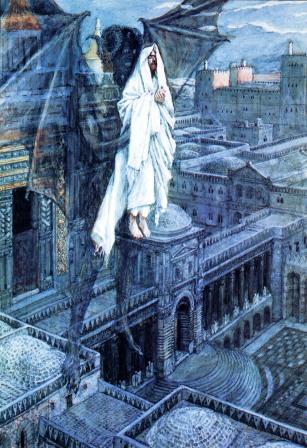 When it comes to understanding power, the last temptation that Jesus faced in the desert (at least in Luke), is the greatest show of strength and power by doing absolutely nothing at all. It was a challenge from the devil to Jesus, to prove that he truly was the Son of God by jumping off the highest parapet of the temple. If he truly was God’s son, God, “would command his angels concerning you, to guard you lest you dash your foot against a stone.” To which, Jesus, unimpressed that the Devil can quote scripture, responds: “It also says you should not put the Lord, your God, to the test.” Booyah! Oh yeah! Take that sucka (gestures included)…That, of course, is what I would have said as the Devil skulked away, because Jesus is that hefty of an adversary even after starving in the desert for 40 days! Most of all, though, it tells me real power is not defined by or proven by show and tell. Think about it, I don’t know anyone who even has a tiny bit of that kind of power and doesn’t use it…including the Son of God because he chose not to. The conundrum for me is this: Since no one else was there, how do we know that the devil wasn’t just a figment of delirium resulting from starvation, and none of these tests ever happened…should it even matter? Even if the story is pure conjecture, it did affect how Jesus understood and utilized God’s power throughout his ministry. Obviously, history tells us of his great miracles and his great authority and ability to command a crowd. Most important to me, however, was that he remained true to all three lessons. He is the most powerful figure in human history because he satiated our spiritual hunger first, showed us by example and parable that true power has nothing to do with amassing temporal kingdoms and controlling others, and most importantly, that trust in God is the true cornerstone, even if it means being subjected to torture and death.
I think about the temptations in the desert a lot, and I worry that as a Church, we are failing the three tests. I am worried that amassing worldly wealth far outweighs the need for spiritual fulfillment. I am worried that controlling the faithful by determining who is fit for everlasting life is more important than empowering people to be just who God created them to be…which is to be a part of the body of Christ, where every part is just as important as the next and not just the ones that hold a higher place. I am worried that we constantly put God to the test by demanding that he answer every prayer the way we want him to…and use the result as proof that he really does love us, or is punishing us for something. As a result of our failure, I’m worried that while the devil may have not been successful in tempting Jesus, he has been successful in tempting the Church…the whole Christian Church.
Power Part ll
 Who really has authority and power in this world? While fasting in the desert, the Devil told Jesus that the authority of this world was his and he could give it to anyone he wished. All Jesus had to do was subjugate himself and worship Satan. To this Jesus (at least in Matthew) grows angry and demands he leaves and reminds him that it only the Lord God that we are to worship and he alone shall we serve. Curiously, I’ve often wondered if Satan really believed he controlled this world, or that it was just a trick, a slight of hand to obstruct Jesus true power. When I look at dictators throughout history who appeared to have control of their respective kingdoms along with the allegiance and worship of their people, their power was always rooted in fear, was transient, and their people always fickle. Selling one’s soul to the Devil for the illusion of power will never really make one powerful. Control over someone isn’t necessarily power over them. No one can take our power without our permission. The Devil can’t give away what never belonged to him in the first place: our free will. Shackles may contain us physically, but the spirit never. Jesus knew this, which is why he knew he could command the Devil to leave.
When I look back over my life, the thought of having some form of a kingdom never appealed to me. I don’t really want that. But there were plenty of times that I felt controlled by someone or some circumstance. In hindsight, I realized that I simply allowed myself to believe the illusion that I was powerless. I later understood that at any time, I could have simply said no and relied on what Jesus said…we get our power from God and serve him alone. But hindsight is 20/20. So, while I can’t change the past, I can change the future. I need not convince anyone that the power they think they have over me is an illusion. I’m the only one who needs to know and believe that they don’t. That is the way to break the bond of power. When that person realizes they can’t control your spirit after all, like the Devil did, they leave…perhaps not without some damage, but that what doesn’t kill us makes us stronger right?
People who desire to rule over others, generally choose those who feel powerless to begin with. Feeling powerless opens the door to being seduced by someone who will promise you anything, all for the exchange of your soul. A hefty price to pay for an illusion. When you build a source of inner strength, you stop attracting those kinds of people and situations. You attract those who will empower you and be empowered by you.
Powerless, Part 1
 I’ve been thinking a lot about power these days and how deeply I think it is misunderstood. When I am feeling most vulnerable and powerless, I look to my greatest role model, Jesus. In chapter four of the Gospel of Luke, Jesus has been in the desert without food for forty days and at this very vulnerable point the Devil comes to tempt him. Initially, the Devil goes right to the heart of the matter, Jesus’ physical needs and tempts him to use his power for personal gain, to turn a stone to bread and satiate his hunger. He refuses, and replies that we cannot live by bread alone. It is a choice between the discomfort of hunger, to which he in his heart knew to be temporary, and satiate a desire to show off his power over nature. That, to me anyway, is a pivotal point. He could have begun his ministry with pomp and circumstance of showing off the power to bend everything to his will and be glorified. But he didn’t. He chose to live and walk as a man, and never use his power for personal gain. Just because he could didn’t mean he should.
When I think of my own hunger, it manifests in many different kinds of deprivations, all that create discomfort. Recognizing that weakness is when I doubt and lose faith and look to try to get rid of the discomfort the easiest way possible, is the exact moment to reject these inclinations and follow Jesus’ lead. If I want to live like Jesus did, I must believe that these weaknesses are only temporary, and choosing be uncomfortable or embarrassed in this moment forces me to access my own true source of power, and satiate my spiritual hunger first. While that may soothe me spiritually and philosophically, I also know what it feels like to be in the presence of someone who plays on a weakness and dares me to prove that I’m not by a show of force. It is tempting to prove to them that I’m not what they say I am and at the same time punish them for exposing and taunting me about it. I’ve fallen into that temptation many times in the past and have used power just to prove I have it. I can truthfully say that I only felt weak afterwards. Avoiding that temptation to prove yourself to someone and to stand tall and not accept the bait is and always will be the greatest show of strength.
So how is the story of changing a stone to bread different from the wedding at Cana when Jesus was asked to change water into wine? In transforming the water into wine, he did it as a sign of who he was. In the desert, there was no one else there. The true source of power isn’t being able to transform a stone into bread or water into wine, but to know the power exists within to do these things first. Is it a subtle distinction? I think so. I really believe if Jesus would have allowed himself to be baited into making that bread, to prove himself, he would have lost it. In Cana, he didn’t really need to prove anything, he didn’t really want to make that transformation either, because he questioned whether was ready. He inevitably did it because his mother asked him to, that this was the moment to start his active ministry. Knowing you have the power to do something and doing it to prove you have it…is a sign of weakness. But using your power so do something and use it to bring others to a greater place is not. I’m sure that choice was always on Jesus mind. It isn’t always obvious if we use power to make ourselves look better or to help others. I struggle with that choice as a parent all the time. And in a time of muscle flexing and sand pissing…i.e., “my God is better than yours”, or “my political beliefs are right and yours are wrong”, or “Money buys power” etc.etc., that struggle becomes all the more difficult. We all need to entertain the possibility in any power struggle whether or not we are taking the devils bait.
The Shoes of Boston
 Literally moments after I published “Step by Step”, I became aware of the tragedy in Boston. While I am still walking in my shoes here in Wisconsin, I immediately asked myself what new steps I could take to appease the horror of what happened. So I want to point out the many shoes of the Saints of Boston, who used their shoes to bring help, comfort, hope, healing and many more unbelievable qualities to those affected by the bomb at the marathon. The response of what happened after the tragedy is proof positive that good does outweigh evil. The evil actions of one can not quell the goodness of the many, that is the most important memory I want to take away from this tragedy. Hopefully it will be what the rest of the world sees as well…that we are not the axis of evil that our enemies portray us to be, but strong, brave and compassionate human beings. America is defined by those people who ran to the victims and offered their help. Our pride is reflected in the eyes of those people who stood together singing our National Anthem at the Bruins game. That is the America that I want to stand up and get noticed…not a blood lust for revenge.
While it is understandable to feel rage after being bombarded over and over again with news of violence, like those Saints in Boston we have to hold on to that same source of goodness that drove them so we don’t let vengeance rule the day. In all truthfulness, I am disgusted by some of the idiotic commentary on social media escalating the blood lust for retribution or even linking our president or the government to the growing tide of violence that has swept our country. I am tired of anger, paranoia and panic being the exemplifying qualities that define America. We are better and stronger than that. When we let the few who have committed heinous acts intensify our distrust of one another, then we accept defeat. I would venture to say most Americans are like those Saints in Boston and it is the voice of those reasonable people who must guide us forward…not those that feed our fear of the government and each other. Grieving belongs to us, vengeance belongs to God.
I pray for peace and justice, for reasonable and level heads to move us forward. As always, first and foremost, I pray that we champion love.
The Ripple Effect
 When it comes to influence, sometimes I think we underestimate the simple things, those simple gestures that may not seem so significant at the moment, but whose gentle influence has somehow altered the path we walk in life. My father-in-law is like that. He is a central figure in our small hamlet of St. Croix Falls, Wisconsin. My husband’s family ran the funeral home in town, and everyone knows his father John. I always laugh when my husband answers the phone with the phrase “Who died?” because I know he is talking to his father, who mentally keeps record of the people in his community. He’s the kind of guy, you could meet once, and I don’t know if it was because he was a mnemonic master, but he would not only remember you but have pertinent details about your family and life events as well. We’d travel all over the country and, it happened all the time, we would be at a gas station in Texas, or some other far out place and someone would come up to him and say, “Aren’t you John Edling?” and talk about how he had helped them, or how he knew a family member of theirs. When I was in Law School, my torts professor had to miss a class because of the death of his mother and when he came back and found out I was married to an Edling, he told me that my father-in-law had arranged the funeral and what a wonderful person he was…(his father had been the butcher in town). Things like that happen a lot. John was voted the best athlete of all time in St. Croix Falls a couple of years ago, his high school basketball team still holds the record for the greatest point spread in Wisconsin state high school tournament history. He in turned passed that passion forward through his children, and countless other town athletes. Even after he stopped driving, he would still find a way to stand on the side lines of every varsity football game.
Right now, John is sick, and he is moving closer to the Kingdom of God. His mortal life may be coming to a close, but the ripples of his influence will go on and on forever. To him, it is effortless to help and comfort people, which is why he is so beloved. Simple gestures are what make him a great person, gestures that touched more hearts than he will ever know, and will ripple outward through others who learned how important those gestures can be to someone’s life. I hope it makes him happy and gives him comfort to remember that. I also know it will give comfort to My mother-in-law Rayola, to Steve and his siblings, Jude, David and Barbara to remember how many lives he has influenced. He is a true character, and in many ways, Steven is just like him…generous to a fault, kind and altruistic, passionate about sports and feels totally comfortable in hanging out in boxer shorts. Blessings John, fear not…I see a heavenly ticker tape parade in your future soon.
Leadership

 The events of this week challenged me to revisit some of the primary qualities of leadership that I studied for my Master’s degree in Organizational Leadership at St. Catherine’s University. At the time, I remember thinking how simple these qualities were and how perhaps unnecessary it was to pay all this money for an actual degree that rests on a lot of simple common sense. But after all these years, I’ve changed my tune. I’ve discovered that common sense isn’t necessarily inherent when it comes to those in positions of leadership, whether it be from the top or down to the bottom of small town America. The thing that struck me most this past week, is the seamless ability for leaders to pass the buck when faced with a crisis. When an issue exists that challenges the function of a group, it is a primary function of the leader to address any issue with honesty and integrity. To say, “It’s not my fault”, or “they just wouldn’t listen to me”, or “they aren’t good enough to be here”, or to simply point the finger in some other direction away from themselves isn’t an examples of acting with integrity or honesty. It is also a primary function of any leader to assess what action is essential for the success of the entire group, and not just themselves…even if it means being honest about a mistake made and accepting the consequences with integrity, be it the leader themselves or a member of the group. The kind of behavior that speaks so much louder than rhetoric, is embracing every opportunity to learn with humility and courage. The need to be right, or infallible often takes over the need to be accountable, embrace our imperfections and learn from the lessons that life brings.
I don’t believe that leadership is an innate quality, it is developed over time in the simplest of ways…often facilitated by facing difficult challenges at the hands of those whose desire it is to overpower, rather than empower. I’ve tried to explain that to my sons after they’ve suffered the wrath of the hierarchy of power in school…they call them “douche-bags” I just call them bullies, that their influence won’t last beyond high school. Maturity brings clarity. I’ve told them if I were able to go back in time with a video-tape of what the “douche-bags” of my time looked like 30 years later and show my young self that this is why you don’t need to cry after being left out of the next big party, I wouldn’t have given them so much power to second guess myself. Making the choice not to drink and behave like a “skank” (also my son’s words) was the best choice in the long run for me. Time has a way of pulling back the curtain and exposing the true nature of those we handed our power; they really aren’t wizards after all. And while I may not have made those choices altogether because of my great leadership skills, I did have people in my life who gave me support for the choices I needed to make for me. More importantly, I learned to choose behavior that matched my belief system, whether or not I got support from the rank and file. Standing up for your beliefs is always hard, but it does get easier the more you do it
I wish there were more examples of the kind of men and women whose actions are void of condemnation but ripe with acceptance and high regard, who are honest and have courage enough to be imperfect and accept the necessary consequences, who don’t hide behind the spin of words that paint false perceptions of perfection, who have the foresight to lead us to a better place even though it may be difficult and most importantly, a leader with such commitment and belief in their mission that giving up in the face of adversity will never even be a remote possibility. I don’t care if it is the pope, or a president or the captain of a basketball team. The kind of qualities I just mentioned apply in any situation. I know there are plenty of examples of great leaders out there, I just want them to pushed to the forefront so they can expose how poorly those in positions of power are really doing when it comes to leadership. So, this week…share on your social media outlets, those great leaders who have influenced you in your life, whether they be Julian of Norwich, a favorite of mine, Martin Luther King, Einstein, or even a great coach. Show the world that there are good and true leaders in the world, whose honesty and integrity make them shine!