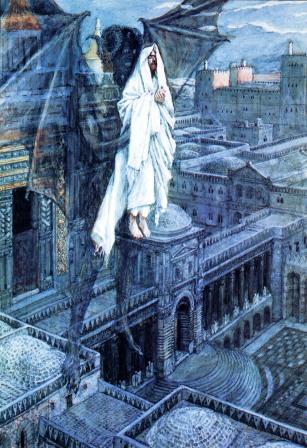
The Kingdom of Heaven

heavenSo how exactly does one go about discovering the rules by which to live?  Rather than filter through all the outside sources available, I began my journey internally because of something intriguing Jesus once said.  In response to a question regarding when the Kingdom of Heaven would come, Jesus replied, “The Kingdom of Heaven cannot be observed, and no one will announce ‘Look, here it is,’ or ‘There it is,’ for behold, the Kingdom of Heaven is within you.”  Clearly, if the Kingdom of Heaven is within us surely it is the inner world that changes how, not what we observe in the outside world.  Later on in the gospel of Mark, Jesus says this about why he spoke so often through parables: “The mystery of the Kingdom has been granted to you.  But to those outside….they may look and see but not perceive, and hear and listen but not understand.” Paradoxically, focusing inward to create a foundation for the rules one chooses to live by seems counter intuitive.  Most instruction and learning comes from the outside in.  Tapping into the Kingdom within is the first and most necessary step in being able to actually see and understand clearly what the outside world stands to teach us.  Think of trying to read in the dark.  A book, no matter how brilliant, is worthless if there is no light to illuminate what is written on the page.  Tapping into my inner resources turned on a light that gave me a different kind of sight, and it has certainly changed how I see the world.

I don’t want to get too hung up on semantics but, the Kingdom within has been described in many different ways: the voice of truth, the cosmic consciousness, intuition, conscience, etc.  Whatever you choose to call it, it is the inner voice which speaks from deep down inside.  Because the concept of intuition is present in many cultures and, for me anyway, doesn’t carry as much theological baggage as and is more feminine than “The Kingdom of Heaven,” it’s the label I’m going to use to describe the melody of the universe.  Intuition, is actually defined as the act of mentally looking into, contemplation, perception; a mental view.  Archetypically, it is associated with all things feminine, especially in many religious traditions.  In Eastern religions, the symbol of the Yin-Yang, or t’ai chi, represents the interaction of opposites such as male/female and light/dark.  It is the combinations of all kinds of opposites that form the world we see.  Culturally, intuition is associated with femininity; it represents darkness, water, instinct and feeling.  Without subscribing to “Emo” culture, we are going to delve into the black side of the yin-yang symbol.  Because it is in basking in the coolness of the yang, that I discovered my own intuition which became a mechanism for accessing the Kingdom within.

Let me also say that getting in tune with intuition isn’t just for women, although we may be given a predilection for knowing how to use it (fodder for another huge debate, but again I have plenty of tales to back this one up).  This is not to be taken as advocating that all you men who are reading this to embrace your feminine side and get all emotional and sensitive (although it wouldn’t be a bad thing).  You men out there should think about being taught by a woman, she may come in a variety of forms but for each and every one of you out there, like a guardian angel, some woman is ready to offer her perspective and it would behoove you to listen.  So let go of the baggage of Eve, the apple and original sin for a moment and look inward to find the prize…and just breathe….and listen for the melody within.

Why did Eve Eat that Damn Apple Anyway?

even and the appleOne of my own first experiences of following my sensibilities occurred early on in grade school.  One day, when my teacher made an innocent mistake in pronouncing a classmate’s name, I raised my hand and corrected her.  Much to my complete amazement she was furious and made me put my head in the desk to “suffer the humiliation of Eve.”   The point of this little story is that my behavior was labeled “bad” for a reason that was rooted in one of the most pervasive assumptions (and one I was constantly plagued with) of all time—women are responsible for original sin, and as part of the punishment we should know our place.

The concept of Original Sin continues to slap women in the face in one form or another constantly.  For the most part, my time in Catholic school was a testimony of penance for that very belief.  For example, a priest once wrote my address on the board when I demanded to know where hell was.  Please save the explanations.  There is no parallel universe anywhere where treating a child like this would ever be acceptable.

So let’s take a look at the story that describes humanities’ fall from grace.  Did Eve’s choice to eat the apple from the tree of knowledge warrant plaguing womankind with that kind of burden?  Yes, she was disobedient, and yes, she convinced her mate to follow suit.  What about Adam’s culpability, though?   Eve had to contend with the serpent, pure evil; Adam just did what Eve asked him to do—how weak is that? (Remember that old maternal adage: if your friend jumped off a bridge would you as well? Well, Adam did.)

Eve suffered for her curiosity and then some, and Adam suffered for his weakness.  There is no inference that Adam was charged with dominating Eve, the two of them were considered one body. According to the first Genesis story, man and woman were created at the same time and God gave dominion over the earth to both of them.  It’s curious that most people only pay attention to the second creation story, where Adam is king of the world and Eve is made just to keep him company.  It is clear that part of Eve’s punishment was that she would  have an “urge” for her husband and be mastered by it—that appears to be an independent struggle for woman to contend with, not an excuse for gender subjugation.  If anything, Adam’s punishment is the clearer representation of slavery; he is destined to toil and sweat until he returns to dust.

Perhaps Eve and Adam knew intuitively that it was time to move on to a place of individual choice, and with that choice they lost their innocence.  Isn’t that the whole point of growing up though?  In order to mature in wisdom we have to leave our childhood behind and take what we’ve been taught and try it on for size.  So rather than getting too wrapped up in original sin and having woman bear the greater portion of it, perhaps it would be more productive to admit that both Eve and Adam made a choice that we have been living with ever since.  Even from the church’s perspective that may not be such a bad thing.  The Catholic Mass at the Easter Vigil has this to say about original sin: “Oh happy fault, O necessary sin of Adam, which gained for us so great a Redeemer!”   It is curious though: when the “sin” becomes a good thing, Adam gets credit for it and Eve isn’t even mentioned?

Focusing so much on the sin detracts from the great responsibility that humans were given: to subdue and cultivate the earth.  The direction of the game of life had been set down.  In order for humanity to be successful, it appears to me anyway, that men and women would have to use their inherently unique talents together: the power of dominion coupled with the grace to nurture the ordinary things that God made.  The formula for this cosmic union is contingent upon male and female rising above fighting over which perspective is right, to embrace both perspectives as necessary to fulfill, successfully, the charge of God.

 Another reason I bring up Original Sin as a fundamental assumption that desperately needs critiquing is that it still fuels one of the most pervasive myths that plague culture: that women are weaker and thus inferior to men.  There are those of you who may think that statement is inaccurate, but really, look around you; there is evidence everywhere of that belief regardless of what level of consciousness you’re coming from.  How many women are in “high places,” positions of power?  Even if you really believe that the place of women in the world isn’t inferior just different, you need only look at the way the law has treated woman in this country.  One need only recall what some of the great jurists (even the fathers of our country) did to women legally, especially in terms of rights.  Rather than assume that the subjugation of women is the natural order of things, I choose to believe it is not.  But if not, how were masses of people led to believe that it was?

While studying theology as an undergraduate, I was aghast at some of the opinions the church’s greatest teachers had about women.  Thomas Aquinas (the guy who pondered the number of angels that could fit on the head of a pin) said in his Summa Theologica, that every woman should have a man as her personal master, because her intellect is no better than that of a child or an imbecile.  What is up with that?  History has demonstrated that statement to be inaccurate.  In all honesty, there have been more than a few men who’ve crossed my path that have defied accepted boundaries of stupidity.  St. Augustine, one of the most influential of Latin Church Fathers and whose work created the foundation for western Christendom, had this to say about women (and it’s a gem): “women should not be enlightened or educated in any way.  They should, in fact, be segregated as they are the cause of hideous and involuntary erections in holy men.”  My response is the same one given to my sons when they point the finger at each other: “Don’t blame someone else because you can’t control yourself.”  My utmost favorite though, is a church writer named Tertullian who said this about women: “You are the devil’s gateway, you are the unsealer of that (forbidden) tree, you are the first deserter of the divine law, you are she who persuaded him whom the devil was not valiant enough to attack, you destroyed so easily God’s image, man. On account of your desert—that is, death—even the Son of God had to die”.  Methinks there was a bit of sexual repression going on there.  Even Martin Luther, a great reformer, believed that women were made by God to be wives or prostitutes.  And don’t even get me started on the Puritans.

But what does a young, female theology student feel when she finds out that many of the founding fathers of western Christendom had pretty skewed views of womankind?  Well, indignation at first, but there was also conflict because much of what these great men had to say was also brilliant.  It was at this point when using common sense, my innate sensibility, regarding the truth of the matter was essential: 1) there are plenty of men who are less intelligent than me; 2) it certainly is not my fault that men cannot control their sexual appetites; and 3) an entire gender, who, by the way was also created in the image of God, isn’t the gateway to hell.  These church fathers had great minds and were brilliant, yes, but like me were creatures of culture and human experience which made them most undeniably—fallible.

Herein lies the problem with our concept of great leaders and rule-makes: a majority of folk take every word, hook, line and sinker of what they say without using any discretion at all.  Generally speaking, their edicts for their supporters are sacrosanct, and those who oppose them are often vilified.   It’s black or white, with no amount of grey in between.  There seems to be a certain amount of infallible mysticism that surrounds the rules they create.  If they are brilliant and/or holy, then everything they say must be right and we must never disagree or criticize them.   Later, when we’ve evolved beyond them, or we tire of them and a flaw or two is exposed, we chew them up and spit them out, or, if they die before we tire of them, we make them saints.  Given that kind of attitude, how can the voice of a common student compare to the voice of the Church Fathers?  Well, if David could defeat Goliath, why not?  Seriously, if the names of the men who said those horrible things about women had been left out, wouldn’t it have been easy to write them off?  There have been plenty of times when I thought the men in my house were demons sent straight from hell, but that is my problem and no reason to make it a sweeping generalization for the rest of mankind.  We often vilify what we don’t understand, agree with, or are afraid of, because somehow on a deep level we do want to subscribe to the “there is only one true perspective” rule.   I, however, find it necessary to dispel this fundamental assumption when ever the spirit moves me—needless to say, the humiliation of Eve never quite stuck.

It is by questioning assumptions that we often have to contend with many conflicting perspectives, some of which seem to fit and others that do not.  It is during the process of questioning, though, that we can begin to recognize that inner voice, one rooted in being a completely unique person whose perspective is of no greater or lesser value than anyone else in the universe.  What I share with others doesn’t have to be right or better than anybody else’s perspective, it just has to be mine.  Have you ever been in conversation with someone and they pull out a masterful source from the Bible or the Constitution just to prove how right they are and how wrong you are?  Ultimately, both of the sources mentioned have always been subject to interpretation.  It is a rarity to hear someone say, “I believe this way because it serves me personally” and just leaves it at that.  Even though my inner voice may be inspired by my faith, it doesn’t mean that I have a better handle than anybody else on the mind of God or what God says to them.  It is the process of sharing our ideas that keeps us moving forward.  Sharing different ideas, regardless of who you are, should be encouraged rather than discouraged because you never know when another person’s perspective may be the needed ingredient for germinating an idea in someone else.  When personal truths are shared, the world becomes a better place.

Let me tell you something else I learned about some of our rule-makers out there: that many of them are completely and utterly crazy.  Throughout my life I’ve witnessed the amazing power crazy people have in establishing rules by which they demand others to follow.  Most often people, (including myself) side step around them to avoid the scenes they create when we don’t follow the rules they set down.  They come in many shapes and sizes, from some of the priests and nuns I had in school to people with substance abuse, or people who are generally miserable people and want to make sure the rest of us are made miserable too.  None of us are on this planet long enough to abdicate our person freedom and follow the rules of crazy people who sap away sanity like syrup from a tree.  Curiously, though, there is an upside to having crossed paths with all you sap suckers out there, because you gave me the opportunity to use and thereby hone my native good judgment.

So, back to the rules in respect to men and women, why can’t there be two equally respected perspectives?  Why can’t we simply appreciate that reality is divided into two equal parts, like two sides of a coin?  Well, besides equality and balance being absolutely no fun at all, with balance there is also no difference, no discord, and without difference there is no perceptual universe.  If there were never any conflicts what reason would there be for any of us go beyond our limitations?   If there were no darkness, could we truly know light?  It’s the same dilemma with good and evil.  Although the rules that I choose to follow may not be the same as yours, and many people in other parts of the world live according to a different rhythm, it doesn’t give me license to “live in my own private Idaho.” My own growth depends on bumping up against other rules and ideas that often run contrary to mine.  That may sound a bit like I am contradicting myself, but just bear with me.

While studying Constitutional Law in law school, I was aghast at the lack of discussion that was encouraged about controversial issues, and in Con Law, there was a new one every day, from abortion to affirmative action.  What saddened me most was that many class mates had their minds made up about an issue already and refused to even entertain the possibility that in actually listening to the “other side” they may be gaining a greater truth.  The atmosphere became not one of  learning, but of debating who was right.  Inside the walls of a law school should be a forum for good intelligent discussion, a place to exercise the skills we were learning: to conflict with each other and in doing so achieve a greater understanding.  Sadly enough, there may be a legitimate reason for societies’ mistrust of lawyers.  The one thing I regret most about law school is that I didn’t take enough time to tell those students and teachers who had thought provoking things to say that I appreciated their insights because it challenged me to look at issues a little more broadly.

So although inequity exists and may be the natural order of things, it doesn’t mean that it shouldn’t be my goal to abolish it anyway and actively engage in conflict with the intent to create harmony, even if the harmony is only internal.  Because it was during my biggest struggles that truth often exposed itself and led me to seek an ever greater truth—inevitably leading to another conflict.  Again, it all turns on perspective.  One person may want to win and have their perspective prevail and happily remain ruler of their own little hill; another person may want to clash just to see what there is to learn in the process.   It makes the most sense to me to choose the latter.  The most important reason not to be too concerned about any controlling perspective is not only are they fleeting, regardless of who claims to be right at any given time, truth has a way of eventually prevailing anyway, like a phoenix rising out of the ashes.  There is so much more out there that we, as human beings, have yet to discover that no one person can ever claim to have any complete answers.  I believe that God has them, but the rest of us are a far cry from being “in the know” like God is.  We simply have to get over the fear to engage in conflict.

As a result of not being in the know, here is another fundamental assumption about the game of life that proved to be inaccurate: that the rules should never change.  The fact is that the rules change constantly, whether we want them to or not, as they should.  As long as humanity keeps moving, discovering, inventing, loving, and hopefully evolving, the one thing we can be sure of is change.  The ending of the game I play isn’t etched in stone; that is the great thing about free will.  The rules I live my life by now are not the same as those that guided my life in my teens, twenties, thirties, forties and yes even my fifties.  There may be a consistent theme in the rules I follow, but I’ve learned not to rigidly hold on to rules that no longer fit my life.

Let me stress that although there are certain fundamental rules that are necessary they aren’t always obvious.  I’ve usually discovered what they were the hard way but at times there were a few people who were older and wiser that held my attention.  And although there are lines drawn for the kinds of rules that help our world vs. destroy it, I can’t say, unequivocally, what they are.  Throughout my life though, (usually by running smack dab right into a brick wall) I have picked up on some universal themes which are laid out at the end of this chapter.  I am also aware that I can’t change another’s perspective any more than I can make pigs fly—with any level of concentration.  For example, the men in my house won’t be transformed into clean freaks simply because I choose to believe that dirty underwear doesn’t belong on the kitchen floor.  And although my opinions are made known to the men in my house, picking up underwear, laughing about bodily functions, and carrying the burden that it will always be my job to replace the toilet paper are things I’ve simply accepted, one, as a means to preserve my sanity and second, that men and women will always exist together and it would behoove us to try and get along.

So before you continue reading, let me offer a challenge: if you want to free yourself from the chains that bind you then suspend all your beliefs for a moment and try living by the seat of your pants for a bit. The Upanishads (Hindu scripture) says, “Whether we know it or not, all things take on their existence from that which perceives them”.  When you’re done reading, go for it.  Put on your old beliefs if they fit, but in order to see if the rules you are following fit the movie in your head, you should be willing to, at the very least, entertain the possibility that everything you think you know for sure right now maybe nothing more than a shadow created by someone else.  Only you can bring to life the movie that is in your head.  Then it becomes life as you see it, not how it has been told to you.  Oh and one more thing, once I chose which rules I was going to follow, the responsibility of achieving my dreams was on me.  Like the parable of the talents, God has given me a treasure, and it was up to me to go and make something out of it.  That may sound like a big responsibility, but I try to think of it more as a golden opportunity.

Things that I know are true:

1)  Things are not always what they appear to be, so pay attention and don’t judge too quickly—and by all means, have a sense of humor, especially when you’ve judged incorrectly.

2) Shit happens—and that can be a good thing.

3)  One need not be perceived as an influential person to be a powerful influence.

4)  What goes around comes around, or a slight variation: what ever you put out there comes back to you tenfold.

5)  Love (or God) is a constant (like in math) and is greater than and is never changed by our perception—love is separate from and not defined by our expression of it.

6)  The opposite of love is not hate, but fear

7)  What is essential is invisible to the eye; it is only with the heart that one can see rightly.

8)  Fame is not necessary for me to shape the world in a powerful way…no one, not even me need be conscious of it.

9)  Real power has nothing to do with control.

10)  Having faith demands that I let go (not give up) of an outcome; and doing that will almost guarantee things will work out.

11)  Just because I cannot understand “why” now, doesn’t mean that I will never understand, sometimes I have to be open to looking at an issue from a multi-dimensional perspective.

12)  Unexplained phenomenon is simply proof that I am continuing to evolve and that I don’t have all the answers yet.

13)  Vengeance never brings peace.

14)  Money is never a reason to do, or not do anything.

15)  I may not control all that happens in my life, but I do control how I respond to it.

16)  Destruction and death are essential elements in growth and life.

17)  Things gained without lessons learned are empty successes.

18)  Without God (love), I am nothing.

Native Good Judgement

10026_CommonSenseThe phrase “common sense” means native good judgment and is derived from the Greek koinē aesthēsis which refers to the total perception of the five senses.  If you have senses, then those of you who read this have, potentially anyway, as much common sense as anybody else.  The problem lies in the execution.  Like any other gift, native good judgment must be exercised. Over my lifetime, my mother and father constantly challenged me and my siblings to use good common sense, and it’s never been easy considering the world we live in.  I never forgot those simple edicts that came from my parents: “If you eat all that Halloween candy, you will get sick”; “If you wait until the last-minute to study, you probably won’t really understand the material and not do well on the test”; “If you treat your siblings like crap, crap is what you will get in return.”; “The most important lessons always contain some form of difficulty.”  Those pearls of wisdom created a strong base for much of my decision-making as an adult, (that and scoring the 97th percentile in an aptitude test measuring common sense…which I’ve bragged about before).  Common sense should also never be confused with intelligence-it is not the same thing.  Some of the most intelligent people I know actually seem to be lacking in common sense.  Like the scarecrow in the Wizard of Oz, they really should give diplomas for that kind of smarts.  The scarecrow discovered that the only way to increase the wisdom of one’s native good judgment is not by always doing what one is told, but by figuring it out on ones own and actually taking personal responsibility for those choices that go awry.

Taking personal responsibility for the choices one makes and developing common sense are intimately connected.   Unfortunately one can’t develop without the other.   Based on what I observe in the world at large, be it politics or religion, common sense is on hiatus.  It has simply left the building.  And that is the root of much my of my anger and sadness about the world today.

While in college, I had the chance to study and to meet Lawrence Kohlberg, a professor at Harvard University who was well-known for his theory of moral development.  In his theory, there are three levels of moral development with two stages within each level.  Kohlberg also maintained that individuals could only progress through these stages one at a time, in order, without jumping any stage.  The first level, termed “pre-conventional” is generally found in elementary school age children.  At stage 1, (ages 1-5) children behave according to socially acceptable norms created by an authority figure.  Obedience is compelled by threat of punishment.  At stage 2, (ages 5-10) right behavior means acting in one’s own interest, “I’ll scratch your back if you scratch mine.”  The next level, “conventional,” is where most of society lies.  Beginning with stage 3 (ages 8-16) right choices are based on being a “good boy/girl or doing what will gain the approval of important others such as parents, teachers or friends.  Stage 4 (ages 16 and above and if they reach it, where most adults remain) is defined by abiding the law and fulfilling one’s obligation of duty.  In this stage, leaders are assumed to be right and individuals adopt social rules without considering the underlying ethical principles involved.  People who break rules, deserved to be punished.

What I found most disturbing was Kohlberg’s conclusion that only about 20-25% of today’s adults (most in their late twenties) ever reach the last level of moral development, labeled “post-conventional.”   In stage 5, people do recognize the underlying moral principles served by laws, and if a law no longer serves a good purpose, they actively work to change it through legal and democratic means.  Respect for the law and a sense of obligation to live by the rules is still important, but an individual uses only legally acceptable means to make changes.   Less than 1% of adults ever make a stage 6 moral decision.  Kohlberg believed, theoretically, that civil disobedience was often how a stage 6 moral decision distinguished itself.  In this instance, breaking a law in defense of an individual right can be justified.  Martin Luther King, for example, argued that laws are only valid insofar as they are grounded in justice, and that a commitment to justice carries with it an obligation to disobey unjust laws and accept whatever consequences may come.

It is the kind of strength of conscience that defines Kohlberg’s sixth level that led me to conclude that developing one’s native good judgment is a necessary step in reaching the latter stages of moral development.  It is by exercising and honing one’s native good judgment that acts as a moral compass in not only determining what rules we are going to live by, but gives an individual the internal fortitude and certainty to actually live by them.

In the Judeo/Christian tradition, we are taught that human beings are created in the image of God so the obvious conclusion is that we should have a great deal of faith in our native good judgment.  If we are going to continue to evolve as human beings it doesn’t make sense to think that by questioning cultural rules we would encourage anarchy, rather, it should encourage just the exact opposite.  It is often through questioning that truth itself becomes clearer and that clarity will ultimately shed light on what rules are working in each individual life.  Of course any challenge to these rules most likely leads to conflict but, it was and still is from this kind of vantage point that I make most decisions to co-direct my destiny.

As I mentioned before, exercising the senses to develop that inherent native good judgment is a must.  Lack of use weakens our ability to use them and leaves one vulnerable to outside influences.  Of course, there are many reasons that all of us have, at times, chosen to disregard what we know to be true, subjecting ourselves to a whole other set of unhealthy rules.  Catholic school taught me that they were the seven deadly sins: pride, envy, gluttony, lust, anger, greed and sloth.  There are a host of others, to be sure, but these seven are as good as any.  Knowing what rules serve a higher purpose doesn’t mean that I was always capable of listening to that inner voice and adhering to them—which is normal because sometimes the best way to learn is by making mistakes.  Note the distinction between discovering what rules are good to follow and actually choosing to follow them; it is very important.  Obviously, the proof is in what kind of choices we have made in our lives thus far and the people who influence us on a daily basis.  However, the more adept we become at using native good judgment, the more difficult it becomes to fall prey to those deadly sins.

It would be inaccurate to assume that “proof” of using native good judgment will always result in being labeled “good” by society.  In thinking of my own childhood a little poem comes to mind: “When I was good, I was very, very good and when I was bad I was clueless.”  The ditty needed changing because sometimes challenging the rules means embracing the willingness to accept judgment as being bad.  Being labeled “naughty” by some of my teachers perhaps was the inevitable result of not behaving as little girls should, meaning I always spoke my mind and never stopped barraging teachers with questions about things that were difficult to wrap my young brain around.  Mind you, I never wanted to be bad; being arbitrary just didn’t come naturally.  All I wanted to know, if I was expected to act a certain way, was the reason why.  Perhaps one of the results of questioning the validity of the rules we follow is to turn up the volume on those innate sensibilities.  So, what does this all mean in practical terms?  Stay tuned…

Let the Games Begin!

the game of lifeFor a moment, imagine the point in time when humankind’s consciousness became aware of itself.  The phrase, “Let the games begin” comes to mind.  From that point forward, complete with cutthroat competition for an elusive prize at the end, whether it be immortality or eternal life, humankind has been in a race against itself up the evolutionary ladder.  Throughout history, humanity has also established cultural rules by which to play.  The rules may not be listed as clearly as they are in a Milton-Bradley game, but they’re there.  Face it; rules are important to any game especially when the stakes include life and death, and in many cases, heaven.   I don’t have a problem with living by cultural rules, but I do take issue, however, with who made up the rules we are supposed to live by and what it takes to win.   For the most part, history has been retold by a pretty select group of people, usually men of European background.  Why is this fact important?  Because there is a symbiotic relationship between whomever holds power, who records history and  who has made up most of the rules.  The result: defining the appropriate way to observe the world.

Because men have made up most of the rules simply means it has never been a level playing field for anyone that is not in this majority.  Don’t get me wrong, I love men—a lot, so much so that I married one and gave birth to two.  However, in order for me to embrace my full potential and become that unique ingredient in making a better world, it was and still is a necessity to challenge and question cultural rules, regardless of how far women have come in our historical journey, there is quite a distance left to travel.  Dreams begin their genesis in a form that is as small as a mustard seed.  And it is often the perimeters and basic assumptions created by cultural rules that are the biggest impediment to a dream’s development.  As a woman, I am certainly aware of what impact they had on mine.  It is sad to think of the dreams that may have died because they weren’t able to  thrive a midst the rules imposed by one’s culture.

A favorite philosopher, Alfred North Whitehead, said that in investigating any philosophy of an era, there will be fundamental assumptions that adherents to that philosophy will presuppose, even if unconsciously.  These assumptions appear so obvious that the people adhering to them don’t even know they are assuming them because putting them another way has never even occurred to them.  These assumptions also color the way in which we observe the world.   Eternity with God in heaven for those who follow the right rules and eternal suffering with the Devil in hell for those who don’t are two simple examples.

Since all of us are a part of, potentially, many different philosophical groups (religious, political, economic, etc.) it is important to ask what the fundamental assumptions of these groups are, and how are said assumptions translated into rules, and by following said rules, who exactly benefits?  Perhaps the most important realization of our time is to consider the possibility that our assumptions about the world are deeply flawed or at least inaccurate, and by critiquing them, there may be a new way to see and appreciate our place in the world.

Essentially, the problem is not that there are conflicting perspectives but that there only seems to be one “right” one that should prevail at any given time.  Whitehead also said that goodness and badness are relative to those fundamental assumptions endorsed by a ruling majority.  Given that we all experience life differently, how logical is that?  And although there are also perceptual inaccuracies based on race and sexual orientation, I am not the person to discuss them here.  Since I am Caucasian, female, Irish, Christian and heterosexual, and this blog is about my observations, I can’t really speak to their perspectives.  However, since male and female go beyond race and sexual orientation, and are universal to being human, hopefully anyone can resonate with some of the fundamental assumptions that exist, involving gender.

All of us are rooted in a gender that is male or female.  While the argument regarding nature vs. nurture still exists, my own personal experience has shown me that biology does affect perspective.  I tried to steer away from gender oriented toys when my sons were small, but no amount of influence on my part to raise them outside gender stereotypes could change the fact that they would rather sleep with a car than a teddy bear, they loved dirt more than anything, they figured out how to pee in the woods before the toilet, and no matter how hard I tried to keep guns out of the house, they made them out of anything else they could find.  I don’t believe in the nature side of the argument in a definitive sense but let me remind you these are my observations.

Scaling it down to the simplest form, look at how gender rules surface every day.  One need only look at the amount of literature that has been put out trying to help men and women understand one another.   Since spending the last several years in a household of men, my husband, two sons, it has become even clearer to me that the world they observe isn’t at all like the one in my head, and is most often the source of conflict in our household.  None of the men in my life think like me. (I’m not sure anybody does, but for the sake of conjecture let’s just say one of the reasons is because I’m a girl)  They march to a completely different rhythm.  The world for them appears to be just one big continuous playing field, one competition after another.  The rules they live by are not the same as my rules.  More than anything, a woman’s perspective regarding the rules of our household is not wanted or necessary for their happiness.  They do, however, know what happens when I am unhappy…life can become pretty miserable.  As a result, they choose to include my rules sometimes, not necessarily because their lives will be enhanced but just so that they get to live-period.  And if on my small level, I have to fight to include my rules in our household, it isn’t surprising at all that our cultural rule makers still disregard women in general.

So, let me just describe my personal jumping off point in shaking the foundations of this historical king of the hill that society has been playing, so to speak (notice the game isn’t called queen of the hill).  For a certain amount of time I held all rules suspended; not so much as an excuse to wreak havoc, but to use a girly metaphor, more to clean out my own cosmic closet and get rid of all the stuff that no longer fit or was, to put it bluntly, just tacky and outdated.  Arguing in favor of any particular new paradigm that only benefits me and trying to shove it down anyone else’s throat will never work.  The reason for starting here, challenging the established rules and assumptions of our present time, had a lot to do with my own personal development.  It never made good sense to follow a lot of rules blindly, especially those that were oppressive, simply because I was born female.

Here again was my first step, and probably the most difficult: accepting the challenge to break away from my own belief systems and rules, and entertain the possibility that they may not have served me all too well, not just from a place of indulgence but of personal fulfillment.  From this standpoint, there was absolutely nothing to lose except, perhaps, the realization that I might be wasting precious time.  If your own life is hunky dory then stop reading right now, no harm, no foul.  But if deep down in your spiritual self you also find there is a sense of discord created by the rules you’ve followed up to this point, then read on and try what I did.  Personal beliefs should at least be scrutinized every once in a while, even if it only acts as a reminder of why we started following them in the first place.  A function of free will is not to embrace matters of belief blindly; Jesus told us that “if you seek, you will find.”

It doesn’t seem logical that questioning the rules that control our lives would have any effect on real truth, especially if the questions stem from a desire to further understanding.  It’s worked for me because I question everything (which contrary to my catechism teachers turned out to be a very good thing) and my faith in God, myself and humanity is even stronger as a result.  Culturally, asking “why” after about the age of three usually labels you a trouble maker, and I’ve had to deal with that unfair moniker most of my life.  Remember the phrase “misery loves company?” well, perhaps enlightenment loves it just as much; the kind of enlightenment that is predicated by artfully and continually asking questions.  There is nothing greater than being in the company of people who want to know and understand as much as they can.

It never occurred to me to get hung up on the notion that even if an individual did disagree with some of the rules imposed by modern culture,that said individual lacked the power to do anything about it.  No personal evolution can take place without individual choice regarding the rules that one follows.  Changing cultural rules may not be easy, slavery and women’s suffrage being only two examples, but the alternative is to choose a life burdened by cultural rules that not only dash ones personal dreams but all the dreams out there that were dependent on your unique perspective.  Has anyone ever told you that the world will be a better place for everyone if you were able to live your dreams?  That my happiness may hinge on yours?  I didn’t think so.  Hopefully, by the end of this little essay you will entertain the possibility  that there is everything you can do about changing cultural rules.  So for now, don’t worry about changing anything, just take a deep look at what makes you tick, and let go of the rest.

So what does one do in the absence of any system of belief, live by the seat of one’s pants?  Well, yes, I guess.  What it boils down to is that people are inherently really quite sensible about which rules are good for them and which rules are not: whether we have the strength to listen to that sensibility and follow it is another matter entirely.   In order to begin perceiving the world from a higher, spiritual place, it was necessary for me to master the inherent gifts God had given me.  And let me tell you there have been plenty of times when I wondered if I had any at all—and that concern turned out to be a gift in itself because it forced to me to keep my eyes open and pay attention and embrace some good common sense…but I’ll leave that for next time

The Secrets of North Dakota

sunflowersFor the last few days, I’ve felt like North Dakota…a never ending, unimaginably boring, flat, hot landscape.  Driving home from Bozeman, I couldn’t wait to get through it.  The reason I feel like North Dakota, is that this space I’m in, i.e. leaving my kid over 1000 miles away, is something I want to get through as quickly as possible…at break-neck speed.  I was surprised by my reaction, watching my 18 year-old impatiently hug me and jump on his bike to ride back to campus to start living his life.  The operative word being “his” life.  He’s really not mine anymore.  And beyond the feeling that I was having a heart attack, right there in that moment, I was afraid that I hadn’t completed my job, that maybe I hadn’t done all that I could do.  Mind you, I know he’s a great kid, but there is that irrational bit that irritated me all through North Dakota.  I just wanted to be done, to feel the ties severed.  Of course, the rational side of me chastised the irrational side for even entertaining that notion, he will forever be my son.

highway artFeeling crappy, I came home to an air-conditioner that didn’t work in a raging heat wave, a washing machine that didn’t work and a mess at my clinic because certain directions weren’t followed and that is all I will say about that, except that I was reminded of a particular point on my drive when I was ready to jump out of my seat from boredom.  Just when I couldn’t stand it anymore, these beautiful sunflower fields popped up.  It was a burst of color that the car-photo doesn’t do justice to.  Then, there was this beautiful sculpture alongside the road that made me smile…who’d have thunk it in North Dakota?  The secret?  Even the flattest, hardest times do contain little moments that get you through the struggle.  It turns out that North Dakota isn’t all bad, so I’m challenged to find the beauty in my own private North Dakota these next few weeks.

Bozeman Bound

bozemanSo, the day has finally arrived!  Connor and I are making the road trip out to Bozeman to get him settled into college.  I’m excited and sad at the same time.  His life in crazy town has flown by, and he is ready for his next big adventure.  It hardly seems possible that I have a child in college, when it was only yesterday that I was in the same position…wondering what life was going to look like, on my own.  It has been full and fun, and never in a million years could I have predicted the road I did travel.  The best advice?  Only plan so much and let the road take you where your heart and passion lead you.  Walk with integrity, truth and a commitment to become the best you, and with God’s help you can never be defeated…unless you try to do it all on your own.  Pray for our safe trip and may it be fun and adventurous!

Let Go, Let Love

loveSo how does one apply this immutable force in everyday life?  Is there some sort of mechanism or practical application that can aid us in harnessing the power of love?  Organized religion, whether or not it seems to be the most obvious choice, is only one place and it doesn’t always do the best job.  It appears to have fallen victim to “there is only one true perspective rule.”  Let me tell you that admitting that love may not be harnessed through organized religion, gives me a great deal of sadness.

The portrayal of love in literature lifts up and celebrates its bond between sex and desire, but as I learned in Catholic school, this dangerous mix also offers, potentially, a lot of sadness. I understand that love and desire can be a lethal combination, but if King Solomon and Shakespeare are correct, it can also greatly enhance human life.  Another wise teacher told me this about love and attraction: “Attraction is like a beautiful coat.  We are all brought into the world with a certain beauty, like a beautiful coat that catches a certain person’s eye.  But it is, after all, only a coat merely attracting someone to the true essence of a person.  Truly, how can a simple coat compare to the beauty that lies underneath?”

Seeing love as an immutable force also dispels another assumption I had about love: for love to be true, reciprocation is necessary.  In fact, reciprocation should never enter the equation.  In the First Letter of John, in the Christian New Testament I used to ponder this line: “Love, then, consists in this: not that we have loved God, but that God loved us and has sent his Son as an offering for our sins”.  We should never choose to love expecting that it will be returned.  Loving another should be open ended and fearless, for John continues, “Love has no room for fear; rather, perfect love casts out all fear.  And since fear has to do with punishment, love is not perfect in one who is afraid.” 1 John 4: 7-9.   When we love without fear, the consequence often inspires reciprocation but it is in no way contingent on it. Love should never be withheld when it isn’t returned because then love’s true power becomes squelched (just ask any parent).  It was enduring the experiences of unrequited love where I learned the most about love’s true nature and was transformed as a result.  Those experiences may have caused burns but it was also those experiences where I began to discover how to wield love’s energy effectively.  Love is often most powerful when it continues to propel us forward even in the face of opposition.  When you look at love this way, the phrase “love your enemies” begins to make a lot more sense.

As an individual, the most important insight that I gained through all my trials was that the power to love on my own would always be deficient, leaving me vulnerable to harm.  With God, though, who, is love, my heart is augmented with a power that knows no boundaries.  I’ve truly found that even with the limited capacity humanity has for a full understanding of its nature, when openly and embracing the love of God, we are transformed.  For me, being burned isn’t so much of a concern any more because I have become flame-proof.  That is quite a statement to make and I have never been quite as confident to say it as I am now.  In consciously praying for God to assist my simple heart, I get results.  I can’t explain it any more clearly than that, except to say for those of you who may believe that I’ve just embraced another illusion, that the results I get aren’t anything I could have foreseen.  Of course there are always set backs, but the knowledge and experience of its power never goes away.  It’s like riding a bike—once you learn how, you never forget.

As a parent, I also have the opportunity to experience love on an even greater level.  Throughout the lives of my children, i have engaged in many things that as I single person I never would do, from boy scouts and camping, to endless amounts of time in my car and sitting on my ass while they fulfilled simple dreams.   I always talk about life in crazy town, and with three men I have very legitimate reasons for saying so.  But love is a little bit cray-cray.  When we put personal desire aside for the sake of one we love, amazing things can happen.  I was never transformed into a person who enjoyed the activities of the men in my house—in fact I still wouldn’t choose them for myself.  Yet some how I am still renewed and transformed.   It is hard to put it into words, but like the Grinch I really feel my heart grow 10 times its size, even if it is for just a few moments.

The discovery here may seem to be a simple twist of the language, but it really isn’t.  If we are to harness the great power of love, it has to be done in the way love intends, not the way we intend it.  This may seem paradoxical, at first.  How can one harness something by relinquishing control?  We can’t change the nature of love any more than we can change the nature of fire.  We, as human beings, place way too much emphasis on what love should look like, rather than simply allowing it to propel us forward.  In the face of that, remember, any expression is incidental.  Opening my heart to love means forsaking all fear and trusting that some power greater than I, knows what to do.  When love is the true conduit there is no mistaking the power that will flow through.  It is truly empowering.  In order for love to move us, we must place our own will aside, because there is too much risk of being burned if we don’t.

Thinking of the moments in my life where I felt love in its purest form move me forward, usually isn’t a Kodak moment.  It usually meant reluctantly letting go of my personal will, and moving through the tightness in my stomach that meant I was moving into uncomfortable territory and watching what unfolded.  The result was always amazing, even in a tough love situation.  The clarity of those moments can never be questioned it is just so pure.  When I allow the force of love, which for me is God, replace my small and imperfect heart, the power of those moments is truly death-defying.

My favorite Gospel is John’s.  It is my favorite not so much because of his poetry, but because of the great lengths to which he goes to help us understand love’s true nature.  For Christians, the death of Jesus on the cross is clear evidence of a love and devotion that continued even in the face of rejection by almost everyone.   It also strikes at the heart of God’s attitude toward human beings.  It isn’t the only story of a god so benevolent that he makes a sacrifice, but it surely is the best one (in my humble opinion).  It also may feel like the love bar is set too high for us lowly humans.  To utilize a power that strong may take some practice.

Normally, Not so Deep

stupid kneeIndeed, I have too much time on my hands…normally I’m not this deep.  I dislocated my knee cap at the fitness center and I’ve been immobile and restricted…Which. I. Hate!  Plus, this is the fourth funeral in two weeks…So,when I can’t move and I see so much death, I start to think…too much…sorry for the intensity.  Last night I had a dream of watching people trying to bike and drive their cars on a road made of sand, needless to say they weren’t getting far….sometimes a hard road gives us the structure to move more easily forward.  Just saying

Like a Seal on my Arm

heart“The day will come when, after harnessing space, the winds, the tides, and gravitation, we shall harness for God, the energies of love.  And on that day, for the second time in the history of the world, we shall have discovered fire.”  Pierre Teilhard de Chardin.


This is one of my most favorite quotes of all time, and what always struck me about it was the realization that fire became most useful to human evolution when we learned to harness it.  Maybe the power of love, like fire, lies in its utility.  Love serves no function in a vacuum or high in the heavens; it demands engagement and a course of action.

When humanity first harnessed fire, civilization rose to a completely different level.  Early civilization understood the ramification of fire in their lives, it was bigger and more powerful than they were, they worshiped it, and they feared it.  As civilization progressed, however, fire was no longer a source of fear; its function became a means of sustenance, of survival. They learned how to actually utilize it to improve their lives.  When it comes to the power of love do we know what its function is?  Have we the slightest clue how to utilize it?

As a child, the Catholic Church taught me that “God is love, God is bigger and more powerful than us, and we are supposed to worship and fear God”.  Looking at love as an adult, especially in view of human history, those assumptions didn’t seem to fit anymore.  Can you really harness what you can’t see or are afraid of?  When it comes to fire there is obvious proof of how successful humanity has been in harnessing it in just about every element of life.  Love, however is quite another story.  Look around.  Where is the proof?  We can wield power through: violence via sophisticated weaponry, money, and political control.  But where is the love?  Violence in schools, terrorism, addiction, starvation, child abuse, and religious wars are just a few examples of how poorly today’s culture has harnessed love’s energy.  From the looks of it, we are missing something.  As a source of power, love appears to sit up high on a shelf like grandma’s best china: brilliant and delicate but hardly utilized for fear of breaking it.  On the contrary, love isn’t fragile, as King Solomon wrote: “for stern as death is love.”  A good way to observe our past failures is to see them as an indicator that we continue to hold onto some pretty inaccurate fundamental assumptions about love and how to harness its power.  We can’t utilize what we don’t understand or fear.  I certainly know that I can’t.

This is a pivotal point in history and like fire, it is important to see love as powerful, life affirming and absolutely necessary for survival. It cannot be worshiped from afar.  Love serves no purpose from a distance.  We have to be willing to get burned in the process of harnessing its strength.  It is at this point where application of everything else from previous posts should be taken into consideration, especially in terms of stripping ourselves of illusions.  Our past assumptions have to be cleaned up in order to determine how to move ahead at this point.  Fear must be placed by the wayside, because as the first letter of John in the New Testament tells us, fear is the very thing that is diametrically opposed to love.  First and foremost, though, as individuals, we need to personally be willing to take love down off the shelf and see it as it truly is.  There are a few, throughout history who have had the fortitude to make the attempt to look at love without blinders on.  King Solomon in the Old Testament, for one, also understood the relationship between love and fire and depicts it beautifully in a poem of a bride and bridegroom:

Set me as a seal on your heart

as a seal on your arm;

For stern as death is love,

Relentless as the nether world is devotion;

its flames are a blazing fire.

Deep waters cannot quench love,

nor floods sweep it away.

Were one to offer all he owns to purchase love

he would be roundly mocked.

So, where do we begin? How do we go about shaking off all the layers of illusion that have accumulated over the years (remember the flasher metaphor)? And once we do that, then, what are the risks that come with learning how to use it?  To be honest, there have only been a few people that I’ve studied who have been pretty successful at harnessing love’s energy, but when it comes to the rest of us, we’re pretty much in the dark.

Perhaps part of the reason that the nature of love isn’t fully understood is that the word itself is often trivialized in language.  It is as easy to use the word love to describe ones feelings about pizza as it is to describe one’s soul-mate.  So, to talk about seeing love in a different way is even more difficult than talking about evil.  What source do I have but my experiences, my observations, many of which are entrenched in a culture that is obsessed with a cartoon version of love?  As a source, how am I any more accurate than anyone else?  Well, this is where it’s necessary to rely on quantum physics again.  As an observer, I am limited to certain dimensions.   Love is not limited.  Love stretches beyond experienced reality rendering our simple human expressions of it incidental in the face of what it truly is.   Love won’t be confined to what I or anybody else determines is appropriate; it is larger than we are.  Without love driving the expression, it is empty.   Let me clarify that last statement; simply saying love is the reason behind an action, even if we are under the misguided belief that it really is guiding an action, won’t necessarily make it so.   Love is so much bigger than our desire for it.

So how can we be sure if love is present and is what propels us forward?   Where do we go to find out what it really is so that we can begin the process of harnessing it?  There are volumes of literature, music, psychology, philosophy and theology that have tried to depict what love really is.  What more could I possibly say about love that would amount to a major discovery?  Are there any new ways to talk about the true nature of love so we may harness its power?  Well, based on humanity’s past observations and experiences of love, we should be able to understand a few things about what it is and what it is not.   Stay tuned.

To See or Not to See

ireland-crossHere is something that must be said.  Simply stated, my faith in God is central to the way in which I observe the world—but that is just me.  Although devout, I wouldn’t describe my faith as typical.  I know I’ve said this before, but as a theology student I was given an assignment to find a biblical passage to represent my faith…my choice?: King David dancing naked before the Ark of the Covenant—draw your own conclusions.  In the rash of religious fundamentalism that has taken hold of many in today’s world, I am almost a bit embarrassed to share my passion and devotion to God for fear of being pigeon-holed as an advocate for some of the idiocy that has come out of some religious fundamentalists.  However, this post can be helpful to anyone regardless of where they are in life’s great journey or what philosophy or theology they embrace.  My purpose here is to simply help people  reflect on, and have a stake in how they choose to observe the ordinary things in this world because it matters more than you may realize.  The many Christian and other spiritual images I use serve to illustrate what I have learned, and they just seem to make a lot of sense to me.  More than anything, it is faith that God is behind me at all times that gives me the strength of this conviction: All things, are indeed possible.

Let me say this: the connections I’ve made based on how I observe the world have led me to new ideas which have resulted in becoming an effective force for change (or a force to be reckoned with depending on the day).  Simply put, I found that most of the materials necessary to live out the movie in my head and the answers to my life’s questions came wrapped in ordinary brown paper, free for the taking.   As much fun as it is to believe that a secret society, centuries ago, has buried the secret to happiness in countless riddles all over the globe, the truth is that it has been right in front of us all along.

The key lies in how to observe the ordinary: using ones own cosmic imagination to see everyday raw materials as essential ingredients in creating something greater, to achieve ones dream.  I may just be stating the obvious, but I’m amazed at how many people don’t even begin to use the simple things that are right in front of them.  They look, but do not really see.  The growing sense of fear and despair in the world is all the proof that I need to bring a message of hope.  Observing the world as one that is evolving into greatness shapes the very way one moves and creates in it.   This is not just another take on “attitude is everything.”  When I use the word “observation,” I’m not speaking about a passive action, rather, one that is the root of all creation and growth.  I, in my ordinary-ness, am as essential a factor in the world’s equation for success as any president or king, because my observations are unique to me alone.  And because they are unique to me alone, they can be the exact ingredient necessary for my greatness somewhere else.

Another observation I’ve made is that too many people want to bypass the middle of any process.  We live in a day and age where the easiest route is always the best route, regardless of the cost.  Having status is far more important than the process by which one attains it.  What happens when one is given something too easily, without the opportunity to earn it?  In an age where technology has made all our lives so much easier, perhaps we have lost the motivation to work hard…for anything.  That may be a hard bit to swallow, but there is evidence out there to prove my point.  I find the amount of money that goes into gambling and lottery pots around the world staggering.  It is certainly more than the GNP of many third world countries in the world.  What really is the end result for bypassing the middle where all the hard work is and jumping to the end?  I think part of the reason that we want to bypass the middle is that there is a subtle underlying message today that tempts us into believing that life shouldn’t be hard, that there are ways to bypass any difficulty and that if you can’t fix it within a moment’s time, throw it away and buy something better.  Sadly enough, there are more than enough individuals out there who have, to put it bluntly, just stopped moving period, forcing the rest of us to find our way around them.

I would also venture to say that most people out there have, at times, considered themselves to be inconsequential when it comes to making an impact on the world. They don’t see themselves as an essential element in something much greater.  It is this belief that has created the grey cloud that is obstructing clear sight.  I am here to say this: the roots of colossal change lie in the smallest and simplest things which often go unnoticed by the naked eye.  When you bypass the middle of any process, you miss all the important stuff.  It is the mustard seed approach that Jesus spoke about: taking something small and seemingly insignificant and learning to have faith in its potential, to put forth the effort to nurture it and see its place in the distant future, far after it has left my circle of influence.  Like the beauty of our DNA’s double helix, every single element is essential in creating the blueprint that becomes a human being.  It is the compilation of many different elements that expresses our potential.  Why not look at our human family the same way?

Being in the middle of a process can also be, at times, tedious, hard work, full of uncertainty, and time-consuming.  It also demands a great deal of humility and faith in the work being done and the process as a whole.  It is my hope to give credit and encouragement to anyone in that middle place, where the effort is not glamorous, but is no less essential than finishing the job.  All of us, at one time or another has had the tedious job of passing a bucket.  Columbus may have been credited for discovering America, but when it came to the discovery of chocolate he was just a middle man

Back to Observation

eyes of graceFrom my unrecognizable place in the world, I’ve seen a lot.   Being in the middle has had its advantages.  I’ve learned a lot from being a middle child, living in the Midwest, graduating several times in the middle of my class, having a middle-income, juggling the challenges of the middle class etc.  Far from being mediocre, though, being in the middle has offered me an equidistant view to the world. From the thick of it, I see an increasing sense of discontentment, anxiety, stress and a loss of hope.  It seems that my penchant for average has kept me, sometimes against my will in a position of observation.  There seems to be a ubiquitous grey cloud that hangs over society today, even a midst the plethora of groups who have laid claim to the key to happiness or in the alternative try to isolate the exact source of our discontent and eradicate it.  In all honesty, most of those groups on high who offer solutions to any and all problems if I would just surrender my control and give into “the right way of thinking” are never all that hopeful or happy, which truly doesn’t inspire much credibility on their part.

And yet, I’m not offering any magical solution either.  However, it doesn’t mean that a solution isn’t there, just waiting to be recognized.  After years of honing my observation skills, I think I understand why we aren’t necessarily in a better place. It all lies in our perception and our ability to see the solution.  No solution to any problem is helpful if you can’t see it.  So let me use another sense to focus on the problem.  Focus on your hearing for a moment: I cannot sing.  I’m not being modest.  I really can’t sing.  But, just because I’m aware of my own limitations vocally doesn’t mean that I also forgo the ability to make a decision about whether someone else can sing or not.  Pretend you’re on a variation of the show American Idol.  Now, instead of it being your job to listen to potential singers, focus on the contestant’s perception of their singing.  The truth, or proof of talent, is what comes out of their mouths, not from voicing the opinion that they are the one you are looking for.  Very often, you respond with incredulity, because it is painfully obvious that many of the contestants are delusional.  Then, just when it feels like there is no hope, and you’re ready to accept anybody that may have only a glimmer of talent, a pure tone and melody presents itself often from the least likely contestant. It is keeping alive the hope, like a beautiful song, that an answer to a prayer exists out there for each one of us. All of us ordinary folk have been inundated with really bad singers for too long now.  The negativity of the information we receive from almost every angle, like nails on a blackboard, is making my head hurt.  Like those terrible singers on American Idol, some people are just plain off-key and should be told so.  When truth becomes buried so deeply under the screeching of the tone-deaf, it does have an effect on the rest of the world, making it harder for the rest of us to hear the clear tones of truth.

Bad things happen, to be sure.  The cure, though, is much more basic and a lot more boring, which may, to many people, make it far less interesting than being delusional.  Truth is often the bitterest of pills and it is indeed a challenge to encourage consumption in a way that is palatable…but I do feel obligated to try.  The answer lies in not what one sees, but how one sees it: the process of observation.  For example, take something simple like the cacao bean, cane sugar, and cow’s milk.   Looking at these raw materials singularly one may not see anything remarkable, but who could have guessed that, as an addendum to a long and adventurous journey of discovering a new world, these ordinary elements would work in concert together to become one of the great culinary discoveries of all time: chocolate.

The fact that chocolate has been a delicacy and has delighted our taste buds for centuries isn’t at all surprising.  What may be surprising, though, are recent scientific studies that have also shown the impact that the properties of the cocoa bean has on our health.  Many of you are probably aware that consuming chocolate releases endorphins : a natural morphine like substance that your body produces that inspires well-being.  Were you aware that chocolate may also improve cognitive function and make your heart healthier also?  Had the cocoa bean been left in its natural and bitter state, perhaps we wouldn’t have been so willing to include it as practically its own food group.  Again, so there is a great food that is good for you, not such a big deal.  The biggest miracle of chocolate though, doesn’t lie in our taste buds or sense of well-being, but how it came about in the first place.

The truly amazing part about the interactions between the Mayans, Aztecs, Columbus, Cortez, and some Spanish monks, is that individually they never intended to discover a new food.  The creation of chocolate is only one example of what can happen when simple elements of different worlds unwittingly merge and then emerge into something entirely new and different.  Like children do, the key is to observe the world in a way that is teeming full of potential.  Perhaps it is God’s intent to present us the necessary raw materials and let our hearts be the source of seeing what ordinary elements mixed together can do to transform the bitter into the delightful.  It also took time, some failures and a host of different players to find the perfect recipe.  The creation of chocolate is the perfect metaphor for the plot of the movie in my head: there is always something great that can come out of any journey, even if it is unintentional.  The challenge is to believe that any road can lead to chocolate by learning to see the infinite potential in ourselves, and the ordinary things and people one sees along the way.  My entire life thus far is a living testimony to this truth.

In a general sense, the purpose of these post’s on observation is to create a cosmic sort of chocolate, so to speak: to create a process by which one can see the world in a way that looks as good as chocolate tastes…and is still healthy for you. It just doesn’t make sense that from this world of amazing raw materials God would give any of us great visuals without also setting us in the right direction and providing means necessary to be a part of bringing them to fruition.   It’s simply a question of being able to see and then bring together the right ingredients. I’ve also learned not to be too rigid about what the final result will look like, to limit the number of roads necessary to get there or even stay around long enough to actually see the fruits of my labor.  And I can say with confidence that I have never been disappointed. Confused at times, perhaps, but never disappointed.

That being said, because each of our lives are different I wouldn’t necessarily expect anyone else to fully understand or appreciate the movie in my head, like I probably wouldn’t fully appreciate what is going on in anybody else’s either.  It’s important to preserve subjectivity.  Not only are we all predisposed genetically to certain traits, we all have accumulated millions of different experiences, resulting in millions of unique personal dioramas.  So really, no one individual will ever see the world in the same way any other does.   This also means that no one else can give you an instruction book on how to live out the movie in your own head.  What I’ve observed is that too many people rely on others to tell them how they must see the world to find success which is one of the causes of the world’s deluded thinking.

The whole point here is not to have you embrace the movie in my head, but to embrace the movie in your own head and learn to observe the world in such a way so that it can happen.  Figuring out what ones uniqueness is and putting it out there in the world to mix with others is the first step.  This is not without challenges, especially in this day and age, because being a totally different and unique individual often runs contrary to societies’ push to be defined by and live within specific cultural rules created by bigger and seemingly more powerful people than us ordinary folk.  It is easy to succumb to the pressure to allow an external standard to tell you what to think and define who you are and your place of importance in this world.  If we all saw the world the same way, there would never be growth, which depends on a myriad of different perspectives, from the grandest to the simplest.  As an ingredient, my addition to the mix might be the most basic, but essential nonetheless.  Like chocolate, it’s the different ingredients coming together that can bring a dream to life.

Because each of us is different, the need to have outside acceptance or approval can be fatal when striving to live one’s dream.  Understanding what goes on in one’s head is central to the individual only.   Don’t get me wrong, acceptance and approval is nice, but it isn’t a requirement.  When I think of some of human histories greatest thinkers, Socrates, Plato, Jesus, Galileo, Shakespeare, Gandhi, Dorothy Day, Susan B. Anthony, Einstein, to a personal favorite of mine, Teilhard De Chardin, they were far more familiar with condemnation than acceptance.  Where would we be if they hadn’t persisted in the face of societies’ disapproval?  The simple reality is that no one else can live my life or fulfill my dreams, but me.   Most of the things that I’ve accomplished in my life never would have happened had I waited for permission, approval, or enough of an understanding by other people of what goes on in my head for anyone to give me support in the first place.

While approval isn’t essential, it is also impossible to achieve one’s dream in a vacuum.  We are all dependent on ordinary elements to make the movie in our heads a reality, whether it comes in the form of a person, an idea, or a simple experience.  And it is being able to see the importance of those simple things and have faith in their potential in whatever guise they are presented to us that will determine one’s failure or success.   Expecting that someone else can give you all the answers will almost guarantee failure, and rarely are they packaged with a bow and flashy wrapping.  Although acceptance by others is never necessary in bringing a dream to life, the knowledge that each individual out there may be essentially the exact ingredient necessary for a dream is reason enough to encourage everyone to “be all that they can be.”  The more I actualize my own dreams, the better chance, even if unwittingly, I can help actualize someone else’s.  How often does that thought come into your heads?  How often to do you start your day with this thought:  I may be the exact ingredient necessary to help someone’s dream come true?  Even if it is in the subtlest way, that thought should change everything about how you observe the world…when was the last time anyone told you that you were essential to success of the world…to the success of building the Kingdom of God?  I thought so.  So, let it start now.  Be cosmic chocolate to someone.  They don’t even need to be aware of it…only you do.

The Golden Mean

Golden-Mean-1

So how does one go about judging perspective?  Is it even appropriate, especially given that we all walk in our own pair of shoes, is there any kind of measurement that we can use to create some kind of standard? Empathy for our fellow humans can only take us so far.  Is there a human blueprint or archetype that we can use as a starting point?  When I observe the men in my house, a great deal of the time I truly believe that I’m the only sane person in crazy town.  Therein lies the rub…is it possible to truly understand perspective when all you have is your own…is there anything substantive to point to judge what is truly illusory and crazy?  I know there are a million self-help books out there, and I’ve actually read a few…but I’m looking for something more subtle.  Is there an underlying beat, deeply embedded in our DNA, that we humans march too?  Let’s talk about the Golden Mean.

The Golden Mean, or Golden Proportion is a particular construct I’ve used to help me give shape and form to a concept that is usually so illusive.   Some of you who read this may be already familiar with this concept and for those of you who aren’t, I’ll explain it to the best of my ability (or you can always look it up in Wikipedia).

The Golden proportion is a special proportion deeply rooted in nature, art, math and philosophy that represents harmony and balance.  According to ancient history, the Greek mathematician and astronomer Eudoxus of Cnidus (c.370 B.C.), noted that when he asked his associates to find the most pleasing placement of a crossbar, they naturally did so according to this proportion, 1 to .618.  Here is a diagram (great thing, the internet).

golden proportion

The golden mean is also called PHI (pronounced “fee”, not to be confused with PI) in the language of mathematics.  PHI was derived from a sequence of numbers created by a thirteenth century mathematician named Leonardo Fibonacci.  The sequence is a progression in which each term is equal to the sum of the two preceding numbers: 1-1-2-3-5-8-13-21, and the quotients of the adjacent terms possessed the property of achieving the number 1.618, which is PHI, or the golden proportion.  PHI is found throughout some of the best architecture in history, including the Great Pyramid and the Parthenon.  You’ll see it in art, (a classic Greek urn, da Vinci’s Vitruvian Man) nature, (the spiral of a sea shell) biology, (the proportion of male to female bees in a honeybee community) and music (organizational structures in music or the shape of a violin).

What was insightful to me was not that we conceptually understand all the implications of the golden proportion, or mean, but that we, somehow by nature, abide by its rhythm.  Somehow we intuitively know this balance point.  Up there out in the world, there is a consistent melody that life moves to.  There is supposed to be a connection to something larger and I think that we stopped listening to that melody a long time ago.  In the human scale, our hearts lie right at the golden proportion point, so it isn’t surprising to me that the heart, not the head is the archetype where true wisdom and love is found.

The lack of reliance on intuition, that internal melody evidenced historically by how dominant pure reason became.  Reason, historically a male characteristic, has been considered superior to intuition.  Think of it, it’s common to tell someone to be reasonable but have you ever heard someone ask you to be intuitive? The general tenor of history has taught that intuition, because it is vague and illusive, is also something that can’t be relied on and is something that should be evolved from, replaced by science and reason, again, probably rooted in that whole “sinful human nature” thing.  There is also plenty of examples in history when it was even vilified—note, burning “witches” at the stake.  In working to regain a better sense of balance in this world, hence a better perspective, there is nothing to lose by looking at the possibility that “reason” may have shown us just one side of the coin. Visiting the other side of the coin, via my intuition, certainly added clarity and a new dimension to my world.   And adding that dimension was as pivotal as learning the world was no longer flat.

Although intuition is intensely personal, outside resources were helpful in learning to tap into it, understanding the golden mean only being one of them.  We all receive plenty of guidance from outside sources, mine happened to be from scripture, scholars, educational programs and all sorts of other mediums and everyday people like my parents.  Most often I listened to these sources not because of a command but as the result of a conscious choice, they hit a harmonious chord deep within.  Like the story of the Garden of Eden, there is a point when we all have to learn to rely on ourselves when making choices.  Ultimately, I am the direct beneficiary of all my personal choices, even if the choice is only limited to whom or what I’m seeking direction. The greatest challenge is to have the courage to let go of the control of the rational world and allow ones self to move according to the rhythm of the universe.  In this age of rigid rules and control it feels overwhelming to trust what’s “out there.”   It has, for me, been the only way that I have stumbled across the answers to many of my life’s questions.  That isn’t to say reason wasn’t essential as a check when something sounded too good to be true.  It has always been the balance of both my innate sense and rational mind that has kept me pretty balanced (unless you ask the men in my house…)

As a result of remaining fairly ignorant about the power of intuition, I wonder how often we second guess ourselves.  The sense of knowing what choice is the right one comes to me by gut instinct far more often than I may realize or accept.  The result of weakening the credibility of our inner voice is that it becomes a whole lot easier for the world outside to dictate how we live.  As you already may realize, the outside world perpetuates a lot of illusions guaranteed to obstruct clear sight.  Without a strong inner voice, it’s easy to succumb to those illusions.  Perhaps living from the outside-in is less effective than to root how we live in the world from the inside-out.  So, from this point onward, try letting your intuition be your guide in what is presented as only one woman’s take on what lies on the other side of the coin.

How we observe the world is essential, but let me go into detail about that later. It was my intuition that added a whole different dimension to the power and accuracy of my observations.  But it isn’t always easy listening to my inner voice.  First, because it means shutting off my own babble long enough to listen and second, by its very nature it tends to be elusive.   In this day and age, it is even more difficult to listen to the voice within sometimes because of the noise of everyday life, from everything we’re wired into, to the noise of modern life outside.   We are all bombarded by sounds from practically the moment we wake up in the morning, and it takes a conscious effort to turn them off.  It is possible, however, to learn how to tune them out.  When things get really crazy and loud in my life, I remember a line from one of the Psalms that says “Be still and know that I am God.”

Because of the mysterious and intangible quality of intuition, it is the perfect place from which God can speak most clearly.  There is a great story in the Old Testament about the prophet Elijah.  As a result of being a zealous advocate for God, Elijah is a hunted man.  He hides in a cave and the Lord speaks to him and tells him to go outside the cave and to wait for him to pass.  Elijah witnesses strong enough storms to shake the mountains and cause rocks to fall, yet the Lord was not in the storm.  Afterwards there was an earthquake and then fire and the Lord was not present in these powerful acts of nature either.  Then Elijah heard a tiny whispering sound in the wind, and it was in the whispering where God was present, and it was from the whispering where he received direction.  Please don’t think I’m representing myself as a prophet: I’m not.  I have, however, taken the MMPI , busted my hump academically, read thousands of books and danced under the full moon naked—okay scratch that last example.  But like Elijah, I do believe God exists in the whispering, from deep down within me.   I am confident in this statement because I’ve learned to get out of my comfort zone and test the wisdom I receive from within and then watch the results.  At least at this point in my life I choose to listen to the presence and direction of God in the whispering—when I shut up long enough to listen

I’m Stuck

missing boobsAll crap aside, I have tried in the last couple of days to 1) figure out what exactly drives me as an observer and 2) figure out how to improve and change what drives me as an observer.  Truthfully, I am stuck.  I’m stuck because there is a part of me, perhaps the part that is rooted in common sense, that absolutely can’t change how I view that portion of the world that is so rooted in illusion that they are convinced it is the rest of the world that is completely insane….I KNOW!  THAT VERY EXAMPLE FITS ME BOTH AS AN OBSERVER AND THOSE THAT I OBSERVE!!!  It is a bit of a conundrum.  So, I have begun to disassemble the illusory elements in my life…which also stands as proof that my willingness to accept that I may just be as crazy as those I’ve been judging, is a sign that I am in fact, not the crazy on in this observer/observed relationship.  Also, the fact that I would never go out in public with my boobs tucked into my pants because I misplaced my bra and shirt is a point on my side as well.

As far as what drives me as an observer, I would say first and foremost it is my faith as a Christian….I KNOW! MOST OF THE CRAZY PEOPLE I’VE OBSERVED ALSO INCLUDE CHRISTIANITY AS THEIR BIGGEST DRIVING FORCE!  That includes, and is not limited to those horrible spirited people who protest funerals, those that think that a woman’s body has special powers to keep from being impregnated when she is “legitimately” raped, and any or all of the “Real Housewives of Orange County.”  So, what happened?  Did we get it wrong?  I, personally, think we did.  This then, is where I will start.  Read this verse John 13: 34 & 35 and answer this question…is this how you understand your faith?  Actually read the whole chapter, it is the story of Jesus washing the disciples’ feet.  A wonderful portrayal of what is expected of authority.

I know that Jesus didn’t just grab a random person off the streets and command them to love like he did and wash their feet.  He loved these disciples.  He had journeyed with them, spent three years with them…he had tamed them.  Because he had tamed them, he knew that they would understand his command.  The ties that bound them on earth were so important when it came to building and continuing his church, and he was no longer physically with him.  They were responsible to each other, just like the Little Prince taught (see post on Taming).  I think is the most important part…I asked myself the same question: How am I responsible to Him?.  I didn’t get tamed by Jesus personally…only spiritually, and it was through a disciple that I came to understand what he was all about.  It is what made me different from any of the others that have made the same claim.  It has put me on a path of not focusing on being better than or being right…but one of being better and responsible to this phrase:  “They will know you are my disciple by how you love one another.”  The break down of illusion starts there.

Taming

the little prince

“What is essential is invisible to the eye; it is only with the heart that one can see rightly”   Antoine de Saint Exupéry.


The above quote, from “The Little Prince,” is where I root the fundamentals of friendship and has helped me harness love, especially in regard to the fragile nature of the human heart these days.  The gist of the tale is this: the wood fox leads the little prince on a journey of establishing ties (friendships, the true essence of taming) which makes the prince’s ordinary rose “unique in all the world.”  In the end, after the wood fox tamed the little prince and it came time for the prince’s departure, the fox was sad.  The little prince could not understand the benefit of establishing ties if the result was to end in possible sadness.  To help him appreciate taming despite the sadness, the fox sends the little prince back to a rose garden to try to understand how all the roses there were different from his solitary rose on his own little planet.  It is in the presence of all these other roses that the little prince realizes that his rose matters more than any of the others because of the time he has spent caring for her, watering her and protecting her.  It is the ties that he established with his rose that has made her so important.

The fox makes it clear to the prince that in order for taming to be successful one must observe the proper rites.  In all it’s beautiful simplicity it means that taming takes time and patience.  At first the fox told the little prince to sit at a distance and do nothing except to allow the fox to see him out of the corner of his eye.  He explains that during this initial phase the prince should say nothing at all because words are the source of misunderstanding.  Everyday the little prince was to sit a bit closer.  He also told the little prince to come back at the same time everyday so that he would begin to know at which hour his heart should be ready to greet him; consistency is everything when it comes to taming.

The wood fox explains that the process of taming causes the world to appear completely different.  For example, the fox had no use for the wheat field but after the prince had tamed him, the golden color of the wheat will always bring him the thought of the prince and give him joy.  The fox will never see the wheat field in the same way again.  It will be larger and more powerful all because he allowed himself to be tamed.  The fox also can live happily because there is at least one person who truly understands him, for one can only understand someone after they’ve been tamed.  After all is said and done and the little prince understands the essence of taming, the wood fox goes on to share a secret.  The first part is the quote cited above, and then he continues with “it is the time you have wasted for your rose which makes her so important…you become responsible forever for what you tame.”

What is particularly poignant about this story, in this fast and furious age in which we live, is that it is the time and effort put forth that makes taming successful.  The nature of today’s world certainly doesn’t endorse wasting time for anything.  The wood fox in The Little Prince believed that humans didn’t understand anything anymore because they tried to buy everything ready-made at stores.  However, there was no store anywhere where one could buy a true friend: friendship demands that we waste the necessary time and observe the proper rites to establish ties.  As an observer, it is those that I have established ties with in this world that have helped transform how I see it.   The world becomes infused with special meaning.  All of us can rework the rules we choose to abide by and focus on our inner rhythm, but ultimately it is the process of being tamed and taming others that put those rules and cosmic music to practical use.

Loss, as foreshadowed in The Little Prince, is a common element in establishing tiesBecause all of us are on different roads, with varied dreams, relationships often change or end.  The up side to this kind of loss challenges us to spend more time reflecting on how the relationships in our lives have affected how we see a wheat field.  Whenever the inevitable happens and those people I’ve established ties with begin a different journey, I’ve learned to look at it as just an opportunity for them to transform a wheat field somewhere else.  Distance can’t ruin ties, only complacency does.  True taming doesn’t rely on proximity.

Taming need not be complicated, but it may seem risky at first.  When you put yourself out there to tame and be tamed you may be rejected.  But just like the little prince did, I’ve found that if you let your heart guide you and observe the proper rites, the chances are that rejection is just an unrealized fear.  Establishing ties with someone practically demands that you put the other person first.  Taming someone for the sole benefit of my own needs almost guarantees failure.   It should come from a place of empowering, rather than having power over.  Trustworthiness is essential.   Remember the last part of the wood fox’s secret: you are responsible, forever, for what you tame.  Although being responsible for what you tame may seem daunting, try to see it for a moment as a beautiful consequence of the process.

Unfortunately taming, like the middle of many processes, is an often passed over step, because it takes time, it takes commitment and it takes patience.  We live in an electronic age that makes everything quick, easy and often anonymous.  Anonymity voids the element of responsibility, and I think it is why the ties of today are so flimsy.  How we establish ties may differ with every thing, person, place in the world, but it still demands those essential rites.  Regardless of the uniqueness of the method, the challenge remains: to reflect on who we have tamed in our lives and more importantly how we handle the responsibility.  It is a powerful thing, this taming process, especially when it commands us to rely on our hearts more than our eyes, for eyes can play tricks whereas the heart does not (contrary to popular opinion that love is blind).

You see the thing about taming is that it is subtle, and it usually occurs over a long period of time.  Those who have truly tamed me acted so subtly and consistently that I wasn’t even really conscious of it at the time, leaving me no time to run in fear.   It need not be complicated and dramatic.  Even though I’m just as big a fan of the being swept away themes in movies, I do realize they are only two hours long.  The rest of us have lifetimes to contend with, we have to go beyond the “and they lived happily ever after” line.  The work is worth it though.  I feel so much better about myself and my world knowing that the relationships I’ve established (and it doesn’t have to be many) are transforming the way others see the world.  I tame because I love; the responsibility then becomes a bonus and not a burden.  It’s not even fathomable to me to imagine what life would be like without them.  Given that life is unpredictable, I do know that even in the face of loss, life will never appear the same again.   I wear them proudly like a seal on my heart.  Now, before I get too verklempt, let me stop now so you may talk among yourselves.

Dancing with the Devil

dancing with the devilI hesitated for a long time before I expressed my rage against this corporate machine, but now that my dance with this particular devil is done…let me tell you about it.  For the past few years, my family has made a special effort to live more simply, pay off debt and choose a life that isn’t inspired by all the physical trappings of modern society.  I’m not saying we live like monks, but we, like a lot of others working in health-care fields have suffered in this economy.  We want to live responsibly and not live in the mentality of blaming the world for the challenges that we may face on any given day.  Some days are better than others.  Today, having gotten out from under the single most Faustian company in the world, Bank of America, I feel free.  The holes in my stomach can heal, the frustration of feeling victimized by a company that is rife with story after story of malfeasance is over.

In all my discussions about power, I thought it was high time I took an opportunity to act powerfully in what, to me anyway, was a situation in which I had none.  Choosing to act powerfully doesn’t always mean having the upper hand.  In this instance it meant seeing a situation clearly, and also affirming the belief that I am a good and honest person who was in need of help solving a problem.  That was my platform.   While I think I’m a pretty good negotiator, I had a very positive and yet completely unfruitful conversation with a representative who was rendered speechless in the end even though the machine he worked for may have won, it was I, not he, who felt powerful at the end of our conversation.  I was completely forthright, made no excuses, wanted to resolve a problem efficiently and then proceeded to state the truth to him that not only were they unwilling to negotiate anything, I was penalized for being truthful and responsible.  Not to go into detail, any time I was put on hold so he could “check with his manager,” he came back with an even more dismal situation.   I asked him how he could stand working for this company, (not at all in a mean way, but more because I was curious) given how stressful this was…he answered me, in a tired voice, that it was his job.  I said, that I pride myself on working with people to solve problems and are usually successful in creating solutions where both sides can benefit.  I repeated back much of what the company touted in their new campaign, that they wanted to help stay connected and help people in their ordinary lives.  Being as ordinary as they come, it appeared to me that the company not only didn’t want to keep me connected they were doing their very best to make life as difficult as possible.  He had nothing to say to that.  Ironically, I felt good after the phone-call because I had done everything I could do on my end.  I ended with phrase:  “You have to know that this will catch up to your company, that the rule of the universe is that whatever you put out there comes back to you.  It certainly has for the rest of us.  But when you have an opportunity to help, and your company literally pays bonuses for pushing people to default, you have to know that eventually you and your company will have pay the price…even if all you do is answer the phone and relay your manager’s message…”  We ended the conversation politely.  I did pray for him that night, more because he didn’t seem to thrilled about working for them.  I know I sounded a bit judgmental but at that moment, it seemed so true.  Also,  he had to go back.  I don’t, and I guess that is why I win.

I learned something too.  All the years our business had a relationship with this company, like millions of others, I never thought about what a monster we helped make.  I get that it was done  completely unwittingly, but we still did our part, and I feel most definitely we paid the consequences.  Isn’t this how a lot of monsters get created?  Not by one thing, but by diffusing it among the masses until they become the catch phrase…”Too big to fail”  Perhaps this is why Jesus talks so much about the difficulty of a rich man getting into the Kingdom of God.  Today, I cut my ties with this particular devil and will for the first time in a long time sleep well.

Power, Part III

?????????????????????????????????????????????When it comes to understanding power, the last temptation that Jesus faced in the desert (at least in Luke), is the greatest show of strength and power by doing absolutely nothing at all.  It was a challenge from the devil to Jesus, to prove that he truly was the Son of God by jumping off the highest parapet of the temple.  If he truly was God’s son, God, “would command his angels concerning you, to guard you lest you dash your foot against a stone.”  To which, Jesus, unimpressed that the Devil can quote scripture, responds: “It also says you should not put the Lord, your God, to the test.”  Booyah!  Oh yeah! Take that sucka (gestures included)…That, of course, is what I would have said as the Devil skulked away, because Jesus is that hefty of an adversary even after starving in the desert for 40 days!  Most of all, though, it tells me real power is not defined by or proven by show and tell.  Think about it, I don’t know anyone who even has a tiny bit of that kind of power and doesn’t use it…including the Son of God because he chose not to.  The conundrum for me is this: Since no one else was there, how do we know that the devil wasn’t just a figment of delirium resulting from starvation, and none of these tests ever happened…should it even matter?  Even if the story is pure conjecture, it did affect how Jesus understood and utilized God’s power throughout his ministry.  Obviously, history tells us of his great miracles and his great authority and ability to command a crowd.  Most important to me, however, was that he remained true to all three lessons.  He is the most powerful figure in human history because he satiated our spiritual hunger first, showed us by example and parable that true power has nothing to do with amassing temporal kingdoms and controlling others, and most importantly, that trust in God is the true cornerstone, even if it means being subjected to torture and death.

I think about the temptations in the desert a lot, and I worry that as a Church, we are failing the three tests.   I am worried that amassing worldly wealth far outweighs the need for spiritual fulfillment.  I am worried that controlling the faithful by determining who is fit for everlasting life is more important than empowering people to be just who God created them to be…which is to be a part of the body of Christ, where every part is just as important as the next and not just the ones that hold a higher place.  I am worried that we constantly put God to the test by demanding that he answer every prayer the way we want him to…and use the result as proof that he really does love us, or is punishing us for something.  As a result of our failure, I’m worried that while the devil may have not been successful in tempting Jesus, he has been successful in tempting the Church…the whole Christian Church.

Power Part ll

satan_before_the_lordWho really has authority and power in this world?  While fasting in the desert,  the Devil told Jesus that the authority of this world was his and he could give it to anyone he wished.  All Jesus had to do was subjugate himself and worship Satan.  To this Jesus (at least in Matthew) grows angry and demands he leaves and reminds him that it only the Lord God that we are to worship and he alone shall we serve.  Curiously, I’ve often wondered if Satan really believed he controlled this world, or that it was just a trick, a slight of hand to obstruct Jesus true power.  When I look at dictators throughout history who appeared to have control of their respective kingdoms along with the allegiance and worship of their people, their power was always rooted in fear, was transient, and their people always fickle.  Selling one’s soul to the Devil for the illusion of power will never really make one powerful.  Control over someone isn’t necessarily power over them.  No one can take our power without our permission.  The Devil can’t give away what never belonged to him in the first place: our free will.  Shackles may contain us physically, but the spirit never.  Jesus knew this, which is why he knew he could command the Devil to leave.

When I look back over my life, the thought of having some form of a kingdom never appealed to me.  I don’t really want that.  But there were plenty of times that I felt controlled by someone or some circumstance. In hindsight, I realized that I simply allowed myself to believe the illusion that I was powerless.  I later understood that at any time, I could have simply said no and relied on what Jesus said…we get our power from God and serve him alone.  But hindsight is 20/20.  So, while I can’t change the past, I can change the future.  I need not convince anyone that the power they think they have over me is an illusion.  I’m the only one who needs to know and believe that they don’t.  That is the way to break the bond of power.  When that person realizes they can’t control your spirit after all, like the Devil did, they leave…perhaps not without some damage, but that what doesn’t kill us makes us stronger right?

People who desire to rule over others, generally choose those who feel powerless to begin with.  Feeling powerless opens the door to being seduced by someone who will promise you anything, all for the exchange of your soul.  A hefty price to pay for an illusion.  When you build a source of inner strength, you stop attracting those kinds of people and situations.  You attract those who will empower you and be empowered by you.

Powerless, Part 1

stone to breadI’ve been thinking a lot about power these days and how deeply I think it is misunderstood.  When I am feeling most vulnerable and powerless, I look to my greatest role model, Jesus.   In chapter four of the Gospel of Luke, Jesus has been in the desert without food for forty days and at this very vulnerable point the Devil comes to tempt him.  Initially, the Devil goes right to the heart of the matter, Jesus’ physical needs and tempts him to use his power for personal gain, to turn a stone to bread and satiate his hunger.  He refuses, and replies that we cannot live by bread alone.   It is a choice between the discomfort of hunger, to which he in his heart knew to be temporary, and satiate a desire to show off his power over nature.  That, to me anyway, is a pivotal point.  He could have begun his ministry with pomp and circumstance of showing off the power to bend everything to his will and be glorified.  But he didn’t.  He chose to live and walk as a man, and never use his power for personal gain.  Just because he could didn’t mean he should.

When I think of my own hunger, it manifests in many different kinds of deprivations, all that create discomfort.  Recognizing that weakness is when I doubt and lose faith and look to try to get rid of the discomfort the easiest way possible, is the exact moment to reject these inclinations and follow Jesus’ lead.  If I want to live like Jesus did, I must believe that these weaknesses are only temporary, and choosing be uncomfortable or embarrassed in this moment forces me to access my own true source of power, and satiate my spiritual hunger first.  While that may soothe me spiritually and philosophically, I also know what it feels like to be in the presence of someone who plays on a weakness and dares me to prove that I’m not by a show of force.  It is tempting to prove to them that I’m not what they say I am and at the same time punish them for exposing and taunting me about it.  I’ve fallen into that temptation many times in the past and have used power just to prove I have it.  I can truthfully say that I only felt weak afterwards.  Avoiding that temptation to prove yourself to someone and to stand tall and not accept the bait is and always will be the greatest show of strength.

So how is the story of changing a stone to bread different from the wedding at Cana when Jesus was asked to change water into wine?  In transforming the water into wine, he did it as a sign of who he was.  In the desert, there was no one else there.  The true source of power isn’t being able to transform a stone into bread or water into wine, but to know the power exists within to do these things first.  Is it a subtle distinction?  I think so.  I really believe if Jesus would have allowed himself to be baited into making that bread, to prove himself, he would have lost it.  In Cana, he didn’t really need to prove anything, he didn’t really want to make that transformation either, because he questioned whether was ready.  He inevitably did it because his mother asked him to, that this was the moment to start his active ministry.    Knowing you have the power to do something and doing it to prove you have it…is a sign of weakness.  But using your power so do something and use it to bring others to a greater place is not.  I’m sure that choice was always on Jesus mind.  It isn’t always obvious if we use power to make ourselves look better or to help others.  I struggle with that choice as a parent all the time.  And in a time of muscle flexing and sand pissing…i.e., “my God is better than yours”, or “my political beliefs are right and yours are wrong”, or “Money buys power”  etc.etc., that struggle becomes all the more difficult. We all need to entertain the possibility in any power struggle whether or not we are taking the devils bait.

Chillin

It’s been busy, and hardchillin by the pool…all the more reason to slow down and take a moment to breathe on this memorial weekend.  Although there is so much to be done, as you can see by the sagging door by our pool, a casualty of a felled tree struck by lightning, it is important to stop every once in a while and breathe in and out and relax.  The world will continue to spin on its’ axis even if we don’t finish every chore.  The world does go on, even after loved ones have passed.  This weekend I resolve to only let positive memories guide and sustain me.  Have a safe and relaxing weekend!

My Graduate

connorSo here we are, Connor John.  You are about to begin the greatest adventure of your life, spring boarding into action all the dreams you’ve been building on thus far in life.  Like most young men, right now you feel so ready to leave the nest and begin life on your own.  You’ve outgrown your life here and are ready to move on.  And as much as I am so proud and excited for you to begin this next step, I am also nostalgic and wary of letting the world have you at the same time.  I have always told you that you were meant to be a great man some day, and that was predicated on your ability to rise to the occasions that were placed before you.  Yes, my head may have exploded a few times when you missed opportunities because you were distracted by something else, but I think that’s true for most 18 year-old’s.  What I want to tell you on this important occasion is exactly why I think you are destined to be a great man someday…and then the rest is up to you.

From the moment you could move around on your own, you were driven by curiosity…mostly expressed by breaking or taking apart everything in sight just to see how it was put together, sadly you could have cared less how to put things back together. You were as curious about people and seemed to inherit your mother’s no filter quality.  Early on, you understood the art of conversation was something that involved an exchange between two people, and you liked to practice on the way to Montessori school.  This was a line you repeated almost everyday: “Mom, let’s talk about the power lines…you start”, and then we’d have an exchange of ideas about the power lines, unfortunately you never let me talk about anything else, and I’d try to get you to sing songs instead.   I’ll never forget your first conference at kindergarten when the teacher asked the school psychologist to be present; my heart sunk to my knees in fear that something awful had happened.  When she told me that you liked to hug everyone, and some kids don’t like that…I literally laughed out loud, some in relief and some in utter shock that we fallen so low that hugging somehow was considered a problem, and then I got incredibly sad.  So, trying to be a good parent and help teach you about boundaries, we had a talk about social bubbles.   Like all the Edling men before you, you just loved everybody and were never self conscious about sharing it. Unfortunately, the world wasn’t quite ready for that lack of inhibition.  It still makes me sad sometimes.

You loved music from the womb, it soothed you and moved you always, as it still does.  When you were little, we went to the wedding of the great niece, I believe, of Lawrence Welk in his home town of Strasberg North Dakota and you were so mesmerized by the accordions played at the reception you begged me for weeks to sign you up for lessons.  After I did my research, and got over the OMG factor of this has got to be the worst instrument ever, (an apology to all you fine accordion players out there) I did a final check on whether or not you were really serious about the accordion, and here was your reply: “No, mom, I changed my mind, I think I’ll learn the glockenspiel instead.”  Well…you ended up with the trumpet, and it’s bass counterpart, the euphonium, and I’m proud of your accomplishments.  Beyond just listening to music, you were the first one to dance to any band that was playing, or yell out to all our friends around the pool, “Hey everyone, how about a dance party!”.  You were the sensation at the dance recitals the girls in the neighborhood would put on.  Remember the group called “Connor and the Connorettes?”, hey it is a great memory, one that always makes me smile.

You were always deeply spiritual, perhaps not in the traditional sense, but then really, neither am I.  I remember once, when you were about 6 years old, in the midst of summer fun at jelly stone park, while we were getting ready for a day full of sun and junk food, (Steve was at Wall-Mart, or golfing…the neighbors reading this will understand) you turned to me and said, “Mom, there is no place in hell that could keep out the love of God, right?”  My neighbor Lisa D’s mouth dropped open at the depth of that statement, but I was used to it at that point.  I also remember you breaking down at a Osceola football game because you had discovered that there were diseases out there, specifically cancer, that didn’t have a cure.  How could God let that happen?  It shocked your small world that some things can’t be fixed, and that there truly is darkness out there.  You were almost inconsolable until the friends sitting around us told you that a cure was just around the corner.  We’ve had some great conversations about faith, and I hope that it will continue to develop as you venture on your own.

Walking to the beat of your own drum hasn’t been always easy though.  When bullied in middle school, I had to explain the concept of male posturing and drawing a line in the sand, you told me that you just weren’t interested in playing that game, that beating down the weak to feel strong was just ridiculous.  And while I agreed with you, it was because you wore your heart on your sleeve and they knew they could get to you that you were an easy target.  There is nothing more horrible for a parent than to find out their child is the victim of bullying, frankly it kept me up nights.  But I also believe that God would never give you anything that you couldn’t handle, and it took all my energy to not to open  up a can of whoop-ass.  I took solace in the fact that adults have always seemed to love you, and talk about what a remarkable kid you are.  Truthfully, I never fully understood why so many of your peers could never see you the way the rest of us did.  You found out the hard way, that choosing to be different isn’t always acceptable.  While you never let bullies define you, you never held it against them either.  You forgave them and from what your class mates have told me, you now hold great respect in your class.  That makes me so proud.  You, with all your hats and freestyle attire, are a true character.

Being proud doesn’t imply that you aren’t flawed, though.  So here is some advice for next year:

1) Wanting life to be easy, won’t make it so.  The best truths in life are the ones that must be fought for; the greatest successes are usually preceded by failure, with the difference being the ability to get back up, learn from your mistakes and work even harder.

2) You are starting fresh.  No one knows you, therefore you have no baggage or reputation to worry about, so remember the golden rule: treat others like you want to be treated.

3) School comes first.  College is a blast, I won’t lie…but you are there first and foremost to obtain an education (and a 3.0 if you’re going to keep your scholarships)

4) Remain true to your values.  It’s true, dad and I won’t be there to nag you, but there will be all sorts of temptations that we can’t protect you from either.

5) Never spend what you don’t have…and that means NO to credit cards.  You’ll thank me some day.

6) Remember the talk about boundaries and social bubbles we had in kindergarten?  Remember all those basics and you’ll be fine.

7) Never pick up a t-shirt or underwear from the floor and smell it, to see if it’s ok to wear.  That is just gross.

8) BRUSH YOUR TEETH.  Your smile is one of your greatest attributes.

9) Utilize your time well.  Don’t wait until the last-minute to do an assignment or study for a test.  OH, AND GAMING AND BEING IN THE MIDDLE OF AN IMPORTANT CAMPAIGN IS NEVER A REASON TO BE LATE FOR OR MISS CLASS.

10) Finally, always remember that you are meant to be a great man some day and that day is today!

I love you,

Mom